Stomach Channel
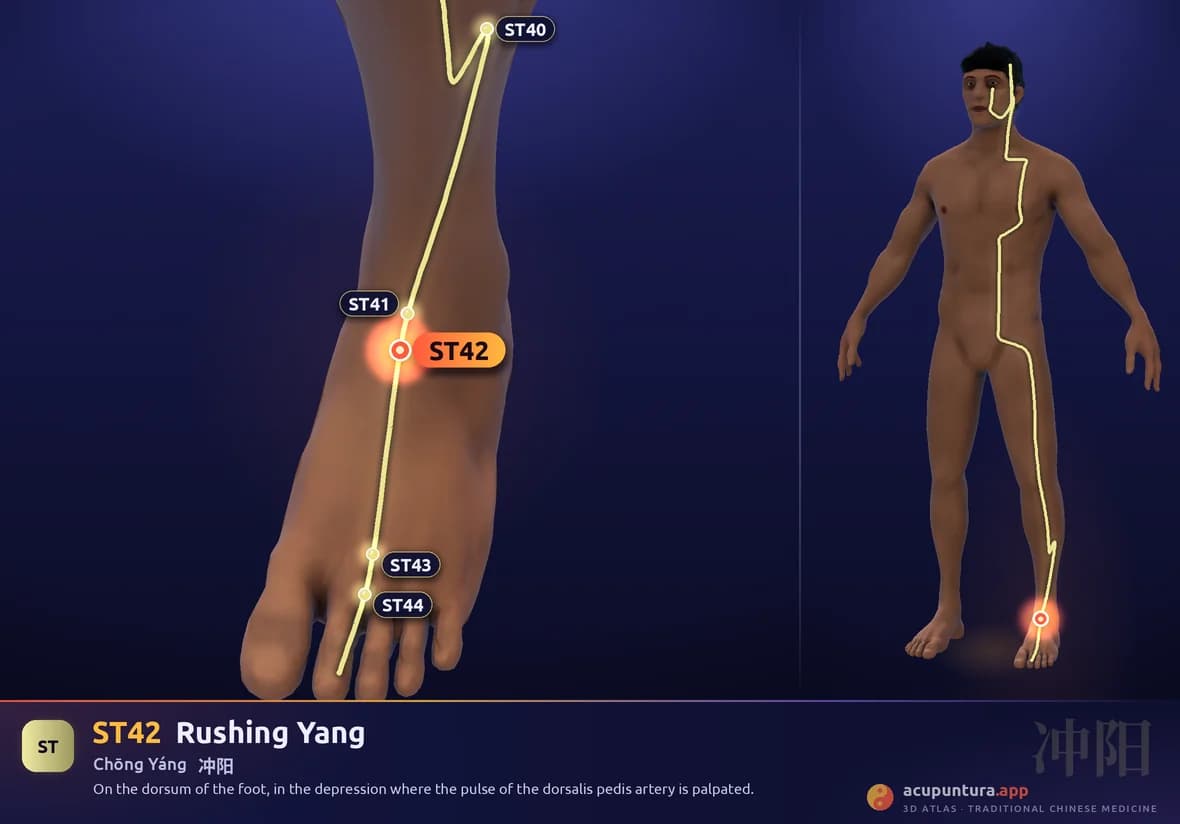
Rushing Yang
冲阳Chōng YángAnatomical location
On the dorsum of the foot, in the depression where the pulse of the dorsalis pedis artery is palpated.
Main function
Regulates the Stomach, harmonizes the Intestine, descends rebellious Qi, benefits the foot.
- Yuan (Source) point
- Ryodoraku point F6 (Stomach)
Therapeutic indications
- Toothache
- stomach pain
- diarrhea
- constipation
- foot pain
- pain and swelling of the dorsum of the foot
- facial paralysis
- atrophy and weakness of the foot
- lack of appetite
- mania
Ryodoraku
F6EstómagoMeasurement point no. 3
Yuan-Source point of the Stomach, over the dorsalis pedis artery. Needle while avoiding the vessel.
Name and classical tradition
Chongyang, 冲阳, is the “pulsing Yang.” 冲 (衝) means to burst forth, to throb strongly; 阳 (陽) is Yang, and also refers to the fact that this is a Yang point on a Yang channel. The point lies over the artery of the dorsum of the foot, where the pulse is easily felt, and the name describes that pulsation. It should not be confused with the homonymous alias of LI20, Yingxiang.
The Lingshu (Spiritual Pivot), in the chapter Ben Shu (本輸), establishes it as the Yuan-Source point (原穴) of the Stomach. Hence one of its alternative names, 會原, “meeting of the source.” But its greatest historical interest lies in diagnosis. In the pulse systems that predate the Nanjing (Classic of Difficulties), which palpated several arteries of the body, this location was one of the pulse-taking sites, together with ST9, Renying, and the cunkou at the wrist.
That tradition left its mark on internal medicine. Zhang Zhongjing, at the end of the Han, uses in the Shanghan Lun (Treatise on Cold Damage) and the Jingui Yaolüe (Essentials from the Golden Cabinet) the term 趺陽, the pulse of the instep, to assess the function of the Stomach with the pulse taken precisely here. 趺陽 also appears as an alternative name for the point, along with 衛陽, the latter with less consensus.
Other names
- 會原Jiayi Jing