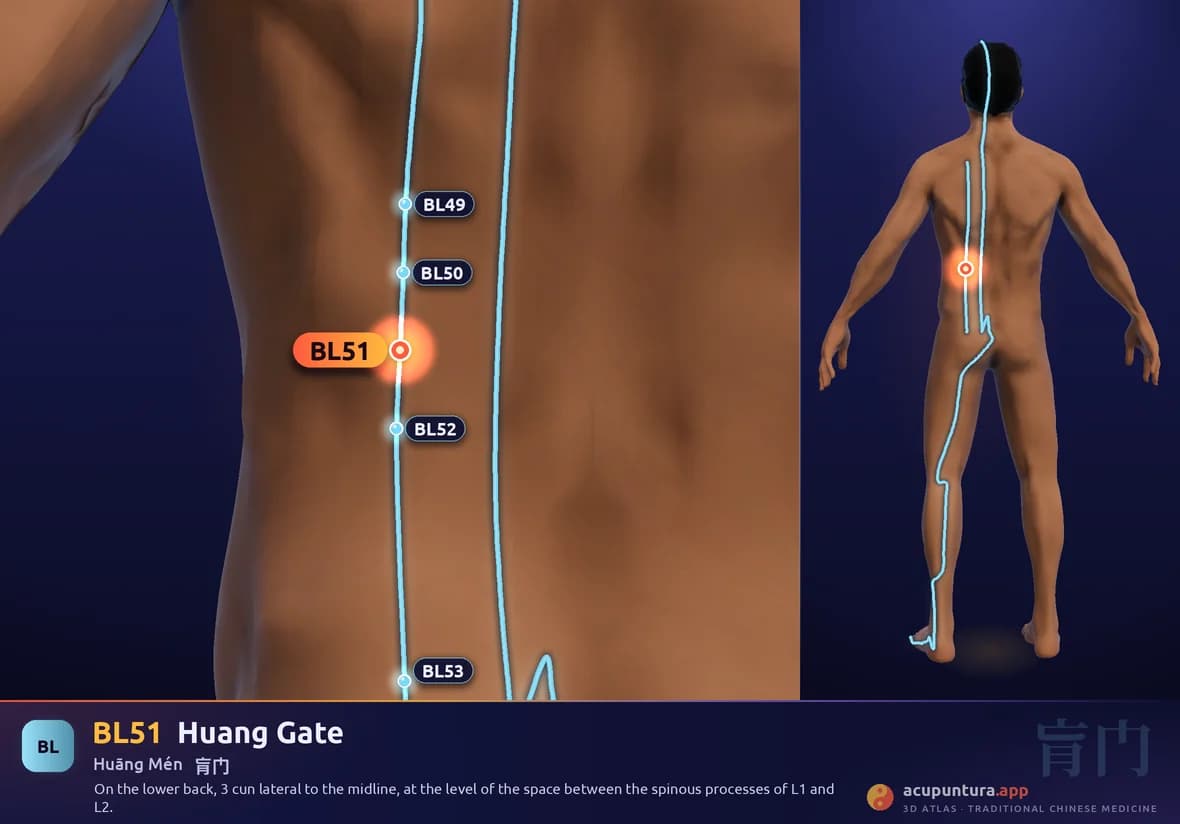
Bladder Channel
Huang Gate
肓门Huāng MénAnatomical location
On the lower back, 3 cun lateral to the midline, at the level of the space between the spinous processes of L1 and L2.
Main function
Regulates the Triple Energizer, strengthens the Kidney, relieves low back pain, regulates urination.
Therapeutic indications
- Low back pain
- abdominal pain
- abdominal distension
- dysuria
- edema
- hip pain
- constipation
- abdominal masses
- mastitis
Name and classical tradition
Huangmen, 肓门, is the “door of the membrane.” 肓 is the membrane, the region of the diaphragm, the same character as in BL43, Gaohuang, here in another combination; 门 is the door. A modern gloss links it to the defensive Qi of the Triple Energizer, which is warmed in that membrane, and the point is on the outer line, next to BL22, the Back-Shu point of the Triple Energizer. It is a reasonable reading, with no classical citation analyzing the name.
The Zhenjiu Jiayi Jing (Systematic Classic of Acupuncture and Moxibustion) locates it level with the thirteenth vertebra, three cun to each side, between the ribs. The Zhenjiu Zisheng Jing (Classic of Nourishing Life with Acupuncture and Moxibustion) of Wang Zhizhong, in the Song period, points out its correspondence with CV15, Jiuwei, on the front of the trunk. It is a verifiable fact about the relationship between points in front and behind.