Du Mai (Governing Vessel) Channel
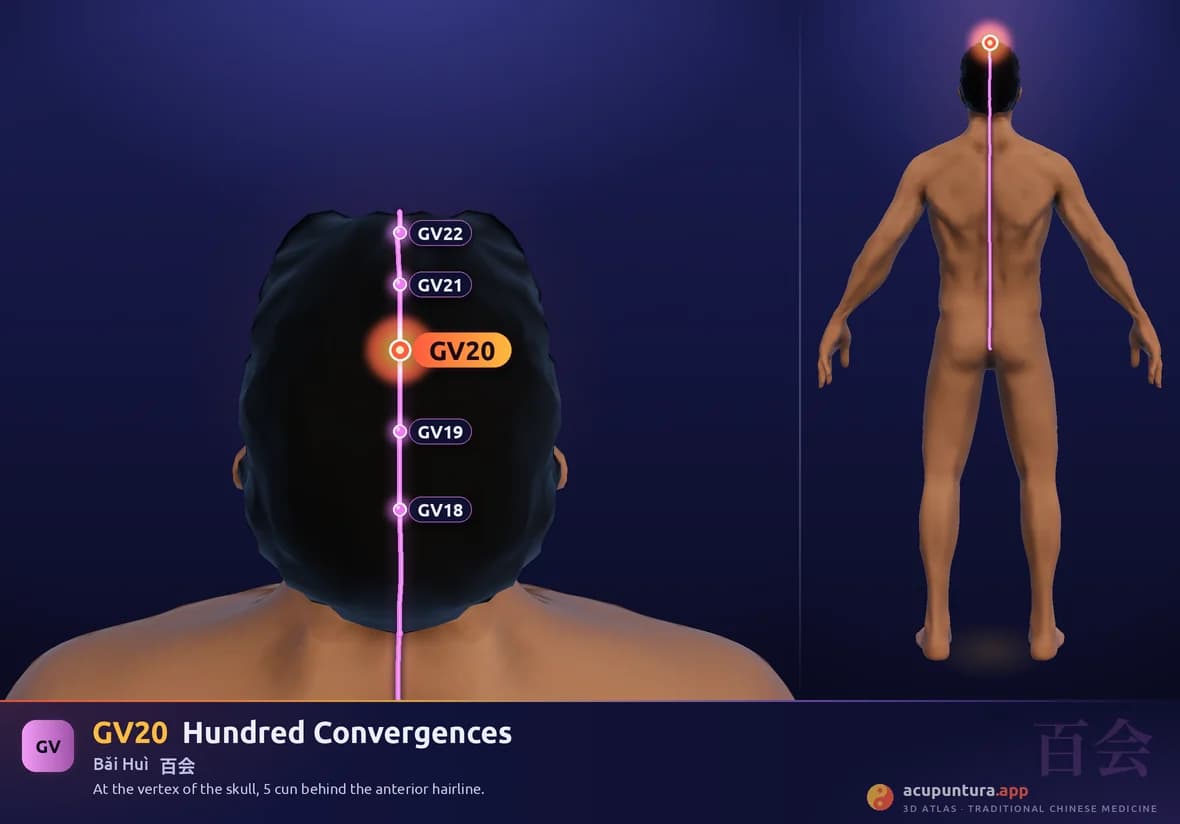
Hundred Convergences
百会Bǎi HuìAnatomical location
At the vertex of the skull, 5 cun behind the anterior hairline.
Main function
Raises Yang, calms Internal Wind, regulates the Shen.
- Sea of Marrow point
- Crossing point with the Bladder, Liver, Triple Energizer, Large Intestine, and Stomach
Therapeutic indications
- Headache
- vertigo
- insomnia
- organ prolapse
- anxiety
- Cephalalgia
- Stroke
- Hypertension
- Memory impairment
- Rectal prolapse
- Uterine prolapse
- Hemorrhoids
- Tinnitus
- Nasal congestion
- Depression
- Mental exhaustion
- Post-traumatic stress
- Obsessive disorder (ruminative thinking)
- Cognitive decline and dementia
- Parkinson’s disease (tremor due to Internal Wind)
- Fibromyalgia
- Tension headache
- Ménière’s disease
- Addictions and smoking cessation
- Allergic rhinitis
- Hypotension
- Alopecia areata
- Acne
Name and classical tradition
Baihui, 百会, is the “meeting of the hundred,” and its name is explained by that of its oldest alias. The Zhenjiu Jiayi Jing (Systematic Classic of Acupuncture and Moxibustion) calls it 三陽五會, “the three Yang and the five meetings.” Two later works try to clarify that formula. The Cai Ai Bian, from the Qing period, says «五之為言百也»: five is a way of saying one hundred, so 百會 would be the meeting of everything. The Yijing Lijie offers another explanation: «是督脈、足太陽、手足少陽、厥陰之會也,故名三陽五會»: it is the meeting of the Du Mai, the foot Taiyang, the hand and foot Shaoyang, and the Jueyin, and for that reason it is called “three Yang, five meetings.” At the top of the head many channels do indeed converge, although the Jiayi Jing, more restrained, recognizes only the meeting of the Du Mai and the foot Taiyang: «督脈、足太陽之會». It locates the point «頂中央旋毛中,陷可容指»: in the whorl of hair at the center of the vertex, in a hollow where a finger fits.
Few points have such a well-dated list of alternative names. The Suwen (Basic Questions), in the chapter Gu Kong Lun, speaks of 巔上, “the top of the summit”; the Maijing, of 頂上; the Zhenjiu Daquan, of 三陽 and 五會; the Biaoyou Fu, of 維會. And the Benshi Fang calls it 泥丸宮, the “palace of the clay ball.” This last name comes from Taoist internal alchemy (內丹), in which the niwan designates the upper spiritual seat, located in the head. It is a notable crossing between medicine and religious tradition.
The sources also attribute to the Zhenjiu Dacheng (Great Compendium of Acupuncture and Moxibustion) a cosmological comparison, «猶天之極星居北», like the polar star that holds the north of the sky, although the citation has not been confirmed. The image is consistent with the place the point occupies, at the center and the highest part of the body.
Other names
- 三陽五會Jiayi Jing