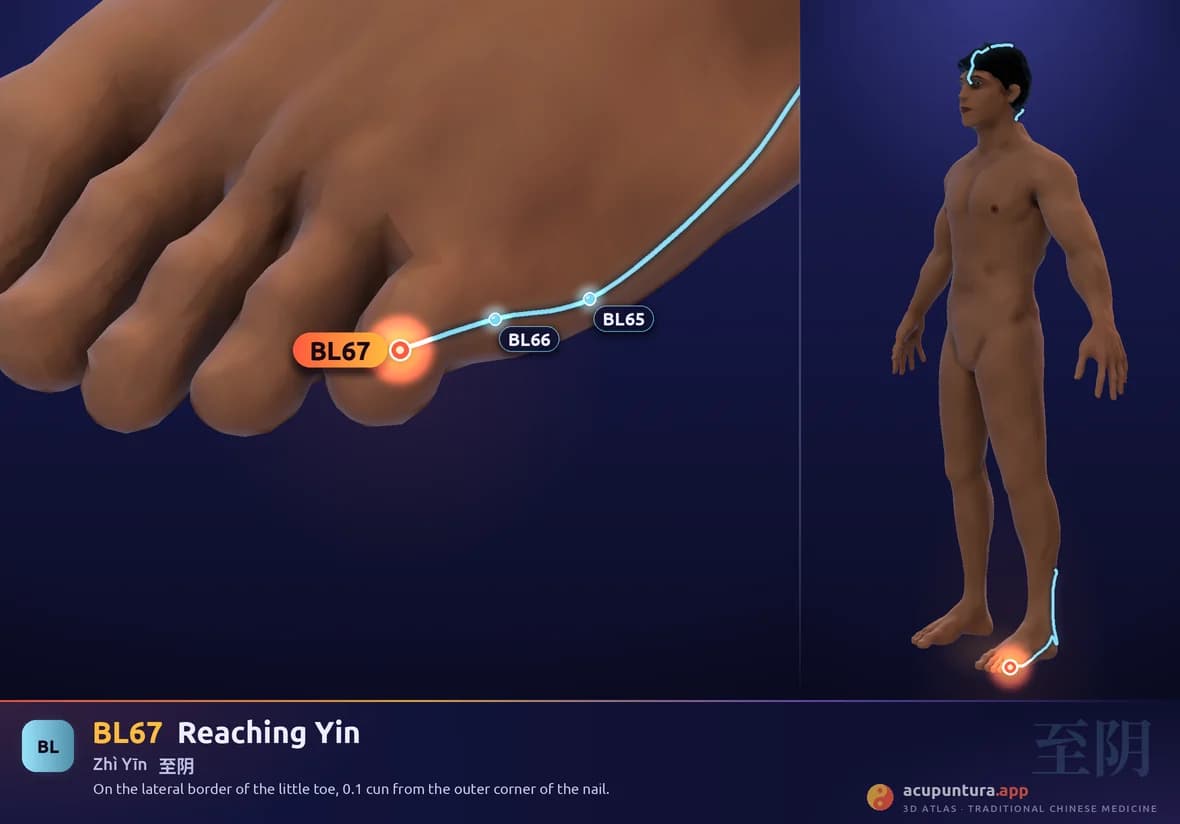
Bladder Channel
Reaching Yin
至阴Zhì YīnContraindicated during pregnancy
Do not needle. Recognized exception: moxibustion between weeks 33 and 36 to turn a breech presentation, under professional indication and supervision.
Anatomical location
On the lateral border of the little toe, 0.1 cun from the outer corner of the nail.
Main function
Jing-Well point (Metal), expels Wind, facilitates childbirth, regulates Qi, clears the head.
- Jing-Well point (Metal)
- Tonification Point
Therapeutic indications
- Occipital headache
- stiff neck
- blurred vision
- fetal malposition
- difficult labor
- dysuria
- foot pain
- Headache
- Nasal congestion
- Nosebleed
- Eye pain
- Breech presentation (moxibustion)
- Difficult labor
- Retained placenta
- Foot pain
Ryodoraku
- Tonification of Bladder
Name and classical tradition
Zhiyin, 至阴, means “reaching yin.” 至 is to reach, to arrive at the extreme; 阴 (陰) is yin. It is the last point of the Bladder channel, at the outer corner of the nail of the little toe, and its name describes a transition: here yang is exhausted and yin begins (陽盡陰起). In the circuit of the twelve channels, the Bladder hands off to the Kidney channel, which begins on the sole of the same foot, at KI1, Yongquan.
The Lingshu (Spiritual Pivot), in the Ben Shu chapter (本輸), places it “足小指之端也,” at the tip of the little toe. The Zhenjiu Jiayi Jing (Systematic Classic of Acupuncture and Moxibustion) specifies that it lies on the outer side, a chive leaf's width from the nail, the same measure it uses for other Well points. It is the Jing-Well point (井穴) of the Bladder, which on the yang channels corresponds to Metal.
Zhiyin is known for a very particular use: moxibustion for fetal malposition and prolonged labor. It is one of the most frequently cited uses in all of acupuncture, although the exact ancient source that establishes it has not been located here.