Kidney Channel
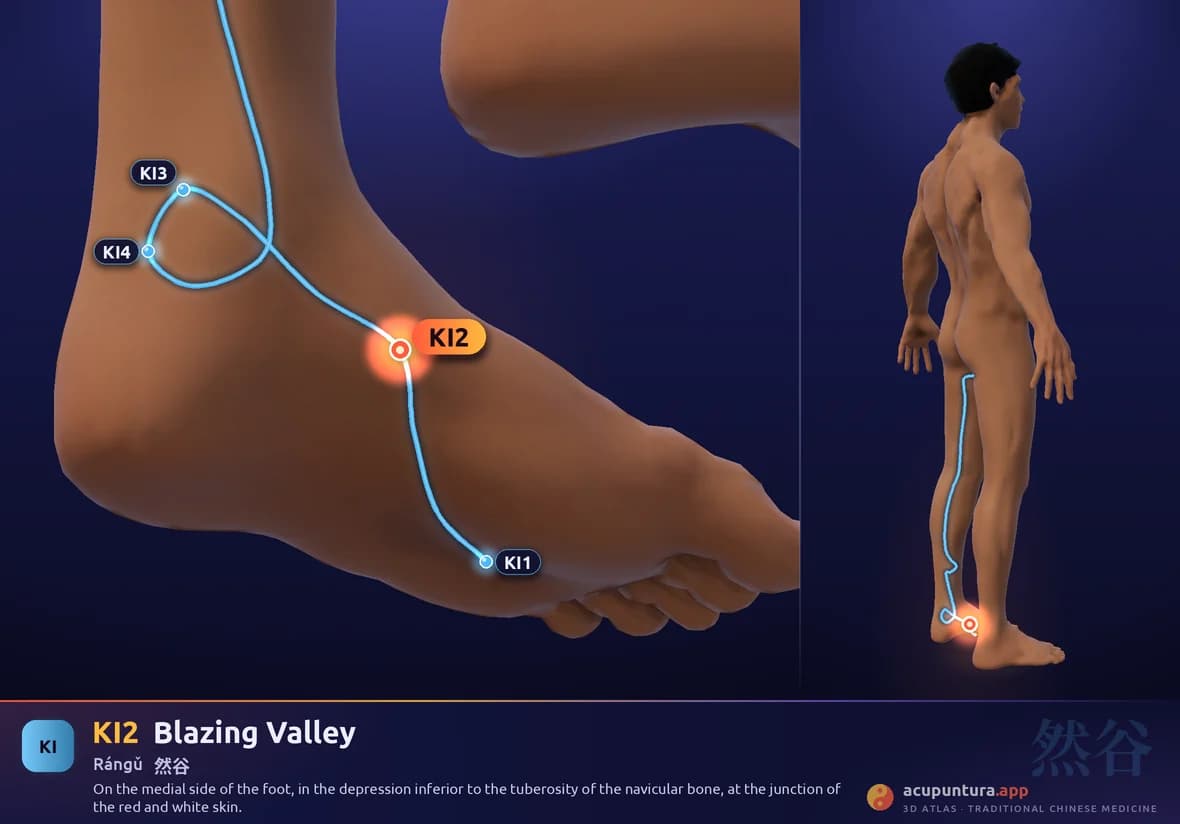
Blazing Valley
然谷RángǔAnatomical location
On the medial side of the foot, in the depression inferior to the tuberosity of the navicular bone, at the junction of the red and white skin.
Main function
Nourishes Kidney Yin, clears Deficiency-Heat, benefits the Lower Jiao, regulates urination and menstruation, calms the Shen, and strengthens the lumbar region.
- Ying-Spring Point (Fire)
Therapeutic indications
- Sore throat
- dry mouth
- enuresis
- urinary incontinence
- dysmenorrhea
- leukorrhea
- impotence
- premature ejaculation
- low back pain
- leg weakness
- pain in the sole of the foot
- Night sweats
- Dry throat
- Intense thirst
- Genital itching
- Menstrual irregularity
- Uterine prolapse
- Dysuria
- Infantile diarrhea
- Instep pain
- Hemoptysis
- Diabetes mellitus (Xiao Ke)
Name and classical tradition
Rangu, 然谷, is a name best understood through its anatomical origin. 谷 is the valley, a depression; 然 does not carry here the sense of “to burn” that is sometimes given to it, but refers to 然骨, the old name for the bony prominence on the inner border of the foot, the tuberosity of the navicular. The Lingshu (Spiritual Pivot), in the Ben Shu chapter (本輸), locates the point precisely by reference to that bone: “溜於然谷,然谷,然骨之下者也,為滎.” Qi glides to Rangu, which lies below the ran bone; it is the Ying point.
It is, then, the “valley beneath the ran bone,” and modern sources suggest the original name may have been 然骨, later turned into 然谷. As the Ying-Spring point (滎穴) of a yin channel, it corresponds to Fire. The usual translation, “valley of blazing,” plays on that Fire and on the common sense of 然, but the basis of the name is anatomical.
The Zhenjiu Jiayi Jing (Systematic Classic of Acupuncture and Moxibustion) gives it the alternate name 龍淵, “dragon's abyss,” and accompanies it with a curious observation: “刺之多見血,使人立飢欲食,” if much blood comes out when it is needled, the patient is suddenly seized by hunger. In its list of forbidden points it repeats this as a warning: “然谷刺無多見血.”
Other names
- 龍淵Jiayi Jing