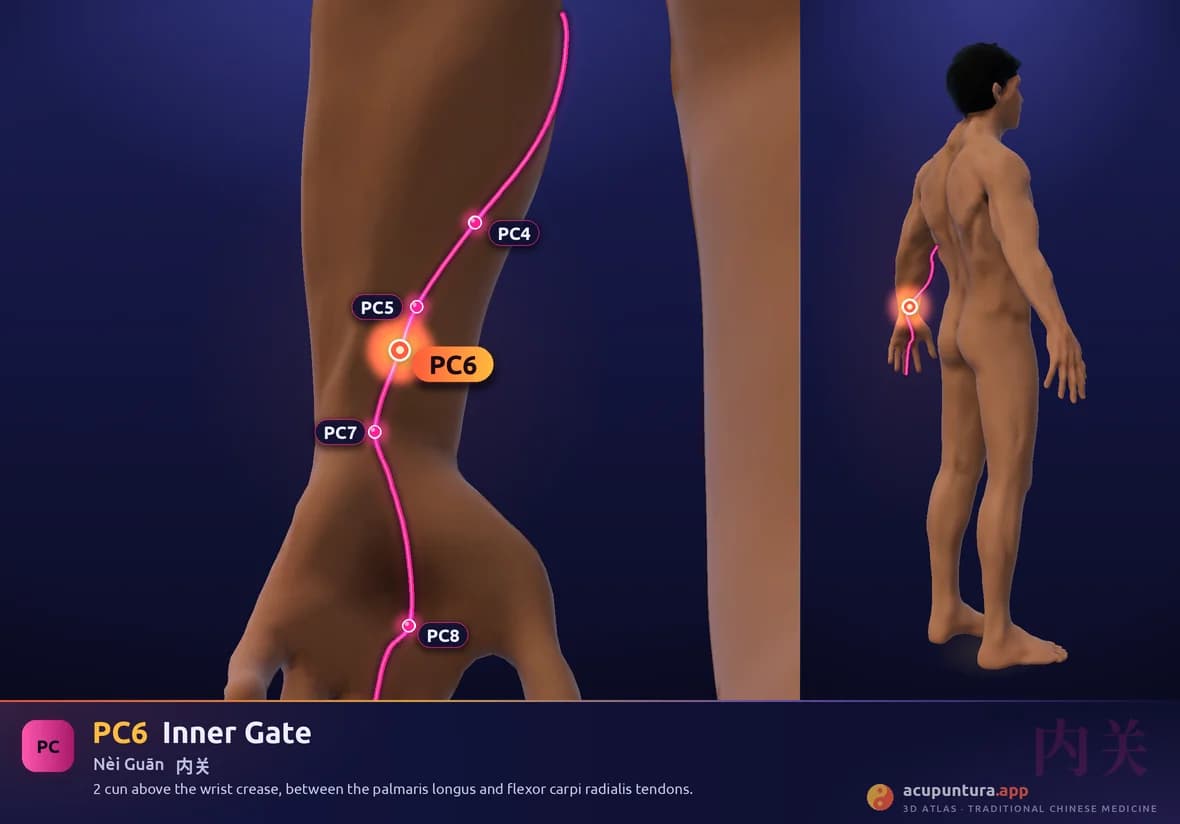
Pericardium Channel
Inner Gate
内关Nèi GuānUse caution during pregnancy
Reference point for nausea and vomiting of pregnancy: it harmonizes the Stomach and descends rebellious Qi. Safe with standard technique.
Anatomical location
2 cun above the wrist crease, between the palmaris longus and flexor carpi radialis tendons.
Main function
Regulates Heart Qi, calms the Shen, harmonizes the Stomach.
- Luo (Connecting) point
- Opening point of the Yin Wei Mai
Therapeutic indications
- Chest pain
- nausea
- insomnia
- hypertension
- Vomiting
- Motion sickness
- Nausea of pregnancy
- Epigastric pain
- Palpitations
- Angina pectoris
- Arrhythmia
- Anxiety
- Depression
- Hiccups
- Elbow and forearm pain
- Epilepsy
- Stroke sequelae
- Panic attacks (Ben Tun Qi)
- Post-traumatic stress
- Obsessive disorder (ruminative thinking)
- Cognitive decline and dementia
- Parkinson's disease (tremor due to Internal Wind)
- Ménière's disease
- Addictions and smoking cessation
- Hyperthyroidism
- Gallstones and biliary colic
- Gastroesophageal reflux
- Low blood pressure
- Chemotherapy-induced nausea and vomiting
Name and classical tradition
Neiguan, 內關, is the “inner pass” or the “gateway inward.” 內 is the interior, and 關 a frontier pass, a barrier. The explanation of the name is found in the text that defines the point, one of the most complete passages the Lingshu (Spiritual Pivot) devotes to a single point. In the Jing Mai chapter (經脈) we read: «手心主之別,名曰內關,去腕二寸,出於兩筋之間,循經以上,繫於心包絡。心繫實則心痛,虛則為頭強,取之兩筋間也».
The collateral of the Heart Master is called Neiguan. It lies two cun from the wrist and emerges between the two tendons. It rises along the channel and attaches to the envelope of the Heart. In excess there is heart pain; in deficiency, stiffness of the head. It is taken between the two tendons. This is the Luo-Connecting point (絡穴) of the channel, the one that connects it with the Triple Energizer, and the text explains why “inner”: from here, a branch leaves the arm and enters the chest as far as the Heart. The notion of a barrier that closes the passage so the Qi of the interior cannot escape, another reading in circulation, is a modern gloss.
Over the centuries another role was added to this one. Neiguan is one of the eight confluent points (八脈交會穴), the one that opens the Yin Wei Mai, hence its alternative name, 陰維. The systematization of these eight points is attributed to Dou Hanqing in the thirteenth century, in his Zhenjing Zhinan (Guide to the Acupuncture Classic). Since the foundational quotation from the Jing Mai, with its «實則心痛», the point has been tied to chest pain and oppression.