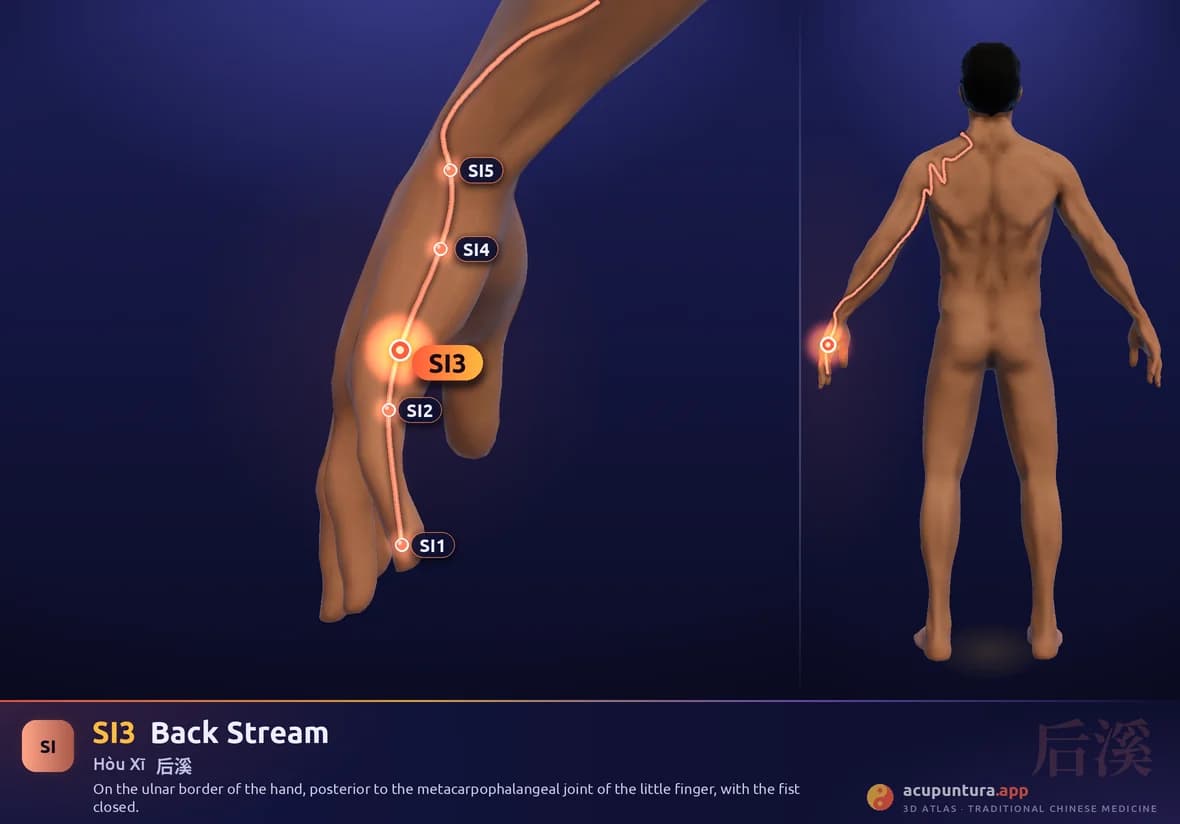
Small Intestine Channel
Back Stream
后溪Hòu XīAnatomical location
On the ulnar border of the hand, posterior to the metacarpophalangeal joint of the little finger, with the fist closed.
Main function
Regulates the Du Mai, relieves neck and back pain, clears Heat.
- Shu-Stream point (Wood)
- Opening point of the Du Mai
- Tonification Point
Therapeutic indications
- Stiff neck
- low back pain
- tinnitus
- headache
- insomnia
- Stiffness and pain in the nape of the neck
- Torticollis
- Back and low back pain
- Epilepsy
- Night sweats
- Deafness
- Red eyes
- Contracture of the fingers
- Malaria
- Mania
- Pain in the elbow and arm
Ryodoraku
- Tonification of Small Intestine
Name and classical tradition
Houxi, 后溪, is the “back stream,” and it is the best-documented point on the channel. The Lingshu (Spiritual Pivot), in the Ben Shu chapter (本輸), describes it this way: “手太陽小腸者,……注於後溪,後溪者在手外側本節之後也,為腧.” On the Small Intestine channel, the Qi flows into Houxi, on the outer side of the hand, behind the joint; it is the Shu-Stream point (輸穴). On the Yang channels, the Shu corresponds to Wood.
后 (後) means behind, as opposed to SI2, Qiangu, the “front valley”; 溪 is the stream, the brook. The image is visible: with the fist closed, the crease of the palm forms an elongated groove on the ulnar border, like the bed of a stream. This anatomical reading is recorded in the Shuxue Mingming Huijie, a modern reference work on point nomenclature. Some also see in 后 an allusion to the back of the body, the back, on which the point acts.
This relationship with the back has a doctrinal basis. Houxi is one of the eight confluent points (八脈交會穴), the one that communicates with the Du Mai, the vessel that runs along the spine. Hence its use for pain in the nape of the neck and the low back, which has been widely popularized in the modern literature. In its current form, that use is contemporary, and it should not be presented as ancient tradition.