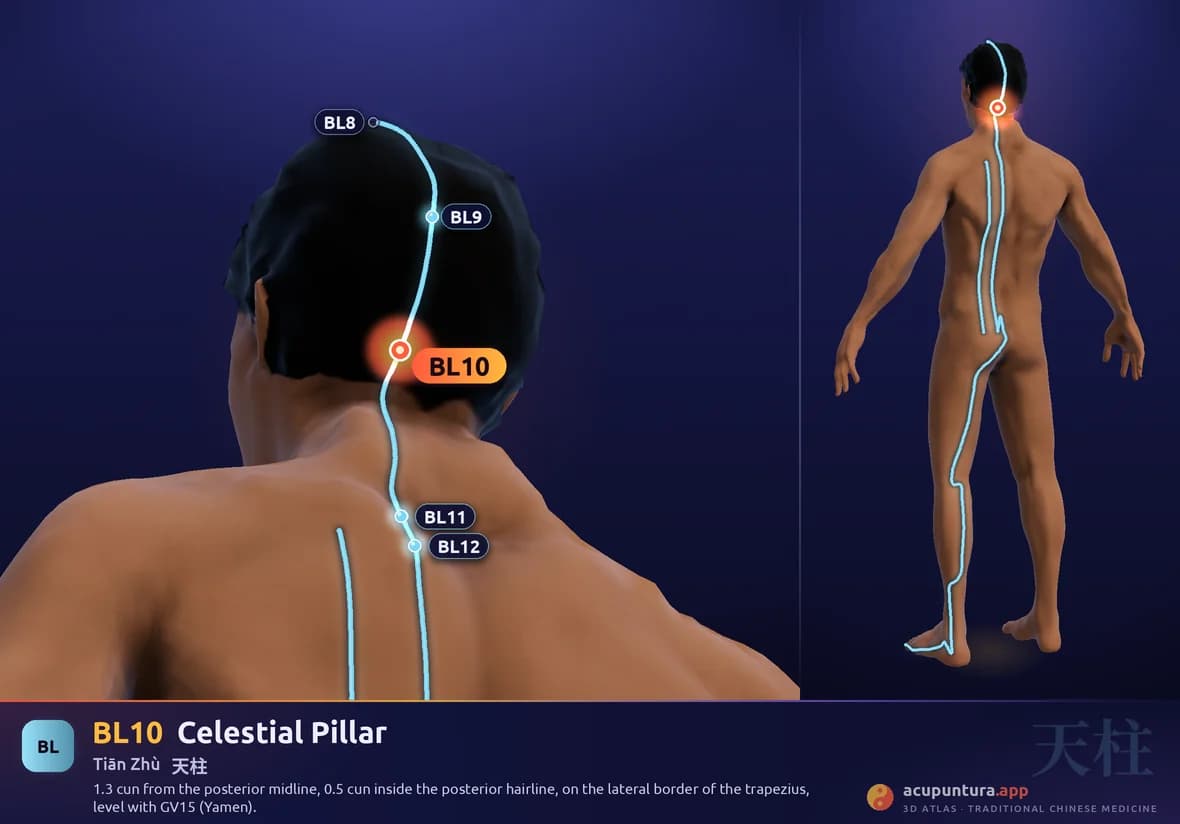
Bladder Channel
Celestial Pillar
天柱Tiān ZhùAnatomical location
1.3 cun from the posterior midline, 0.5 cun inside the posterior hairline, on the lateral border of the trapezius, level with GV15 (Yamen).
Main function
Expels Wind, clears the head, benefits the nose, relieves neck and back pain, calms the Shen (Spirit).
- Window of Heaven point
Therapeutic indications
- Occipital headache
- neck pain
- stiff neck
- back pain
- vertigo
- dizziness
- blurred vision
- nasal congestion
- rhinitis
- loss of smell
- fever
- sore throat
- insomnia
- mental agitation
- epilepsy
- convulsions
- Torticollis
- Shoulder and back pain
- Nasal obstruction
- Mental fatigue
- Tension headache
Name and classical tradition
Tianzhu, 天柱, is the "pillar of Heaven." 天 is Heaven, which in the body is the head; 柱, a pillar, a column. The muscles of the nape, on both sides of the cervical spine, are compared to the pillars that hold up the sky. It is a direct, convincing anatomical image that needs no energetic glosses.
The Zhenjiu Jiayi Jing (Systematic Classic of Acupuncture and Moxibustion) places it "在俠項後髮際,大筋外廉陷者中," at the hairline of the nape, in the depression lateral to the large muscle. The Zhenjiu Jicheng (Compendium of Acupuncture and Moxibustion) mentions it in relation to GV16, Fengfu, and TE16, Tianyou, its neighbors on the nape. The image of the pillar is completed by that of the next point, BL11, whose name also refers to a supporting element.