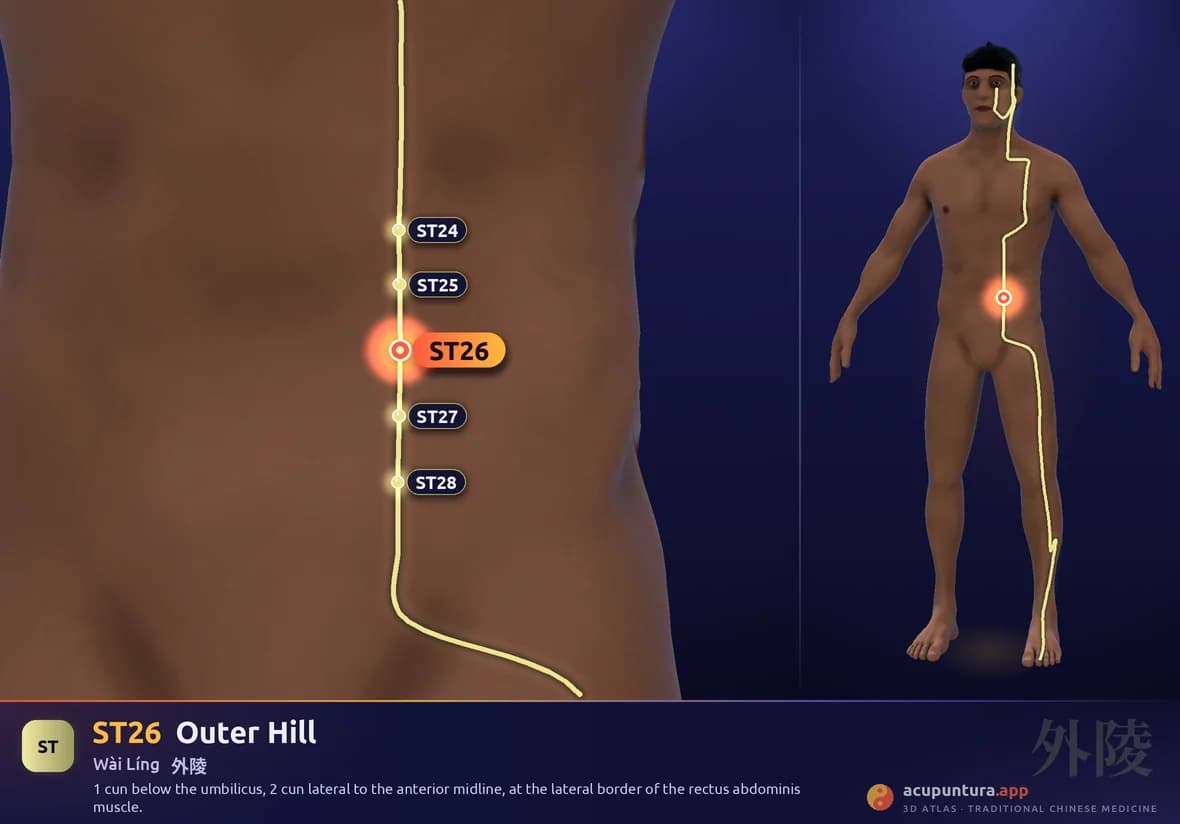
Stomach Channel
Outer Hill
外陵Wài LíngUse caution during pregnancy
Lower abdomen; avoid as the uterus grows.
Anatomical location
1 cun below the umbilicus, 2 cun lateral to the anterior midline, at the lateral border of the rectus abdominis muscle.
Main function
Regulates the intestines, relieves abdominal pain, harmonizes the Lower Jiao, regulates menstruation.
Therapeutic indications
- Abdominal pain
- hernia
- dysmenorrhea
- leukorrhea
- urinary retention
Name and classical tradition
Wailing (外陵) is the “outer hill.” 外 means outer or lateral; 陵 is a mound or hill. The point lies below ST25, where the abdominal wall forms a relief that reference works compare to a small hill. It is a plausible reading, consistent with the use of 陵 and 丘 in other points to name muscular or bony prominences, such as ST34, Liangqiu, or SP9, Yinlingquan.
The Zhenjiu Jiayi Jing (Systematic Classic of Acupuncture and Moxibustion) locates it by reference to its neighbors: “在天樞下,大巨上,” below Tianshu, above Daju. This is a direct quotation. No alias or ancient commentary specific to this point has come down to us.