Triple Energizer Channel
Shoulder Cleft
肩髎Jiān LiáoAnatomical location
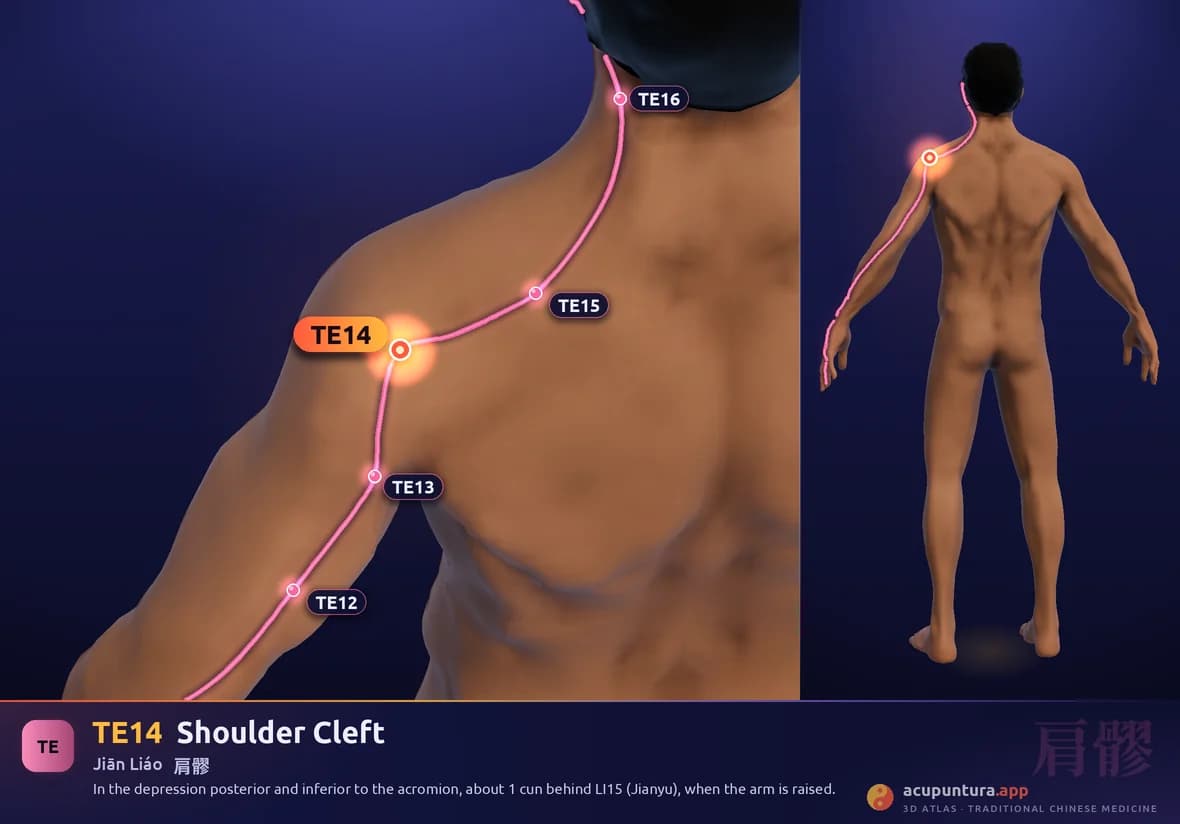
In the depression posterior and inferior to the acromion, about 1 cun behind LI15 (Jianyu), when the arm is raised.
Main function
Eliminates Wind-Dampness, benefits the shoulder and arm, relieves pain.
Therapeutic indications
- Shoulder pain
- neck stiffness
- arm pain
- paralysis of the arm
- headache
- ear pain
- scapulohumeral periarthritis
- shoulder pain and limited movement
- hemiplegia
- hives
Name and classical tradition
Jianliao, 肩髎, is the “hollow of the shoulder.” 肩 is the shoulder; 髎 is the hollow beside the bone. The point lies in the depression that forms behind and below the acromion when the arm is raised, and the name is purely anatomical.
It should be distinguished from the many shoulder points that carry 肩: LI15, Jianyu, whose second character, 髃, looks very much like 髎 and which lies very close by; GB21, Jianjing; SI9, Jianzhen; and SI14 and SI15, the two Shoulder Shu points. The first work to record Jianliao is the Zhenjiu Jiayi Jing (Systematic Classic of Acupuncture and Moxibustion). The modern gloss speaks of Qi descending from TE13 and condensing into rain, with no classical citation.