Triple Energizer Channel
Outer Gate
外关Wài GuānAnatomical location
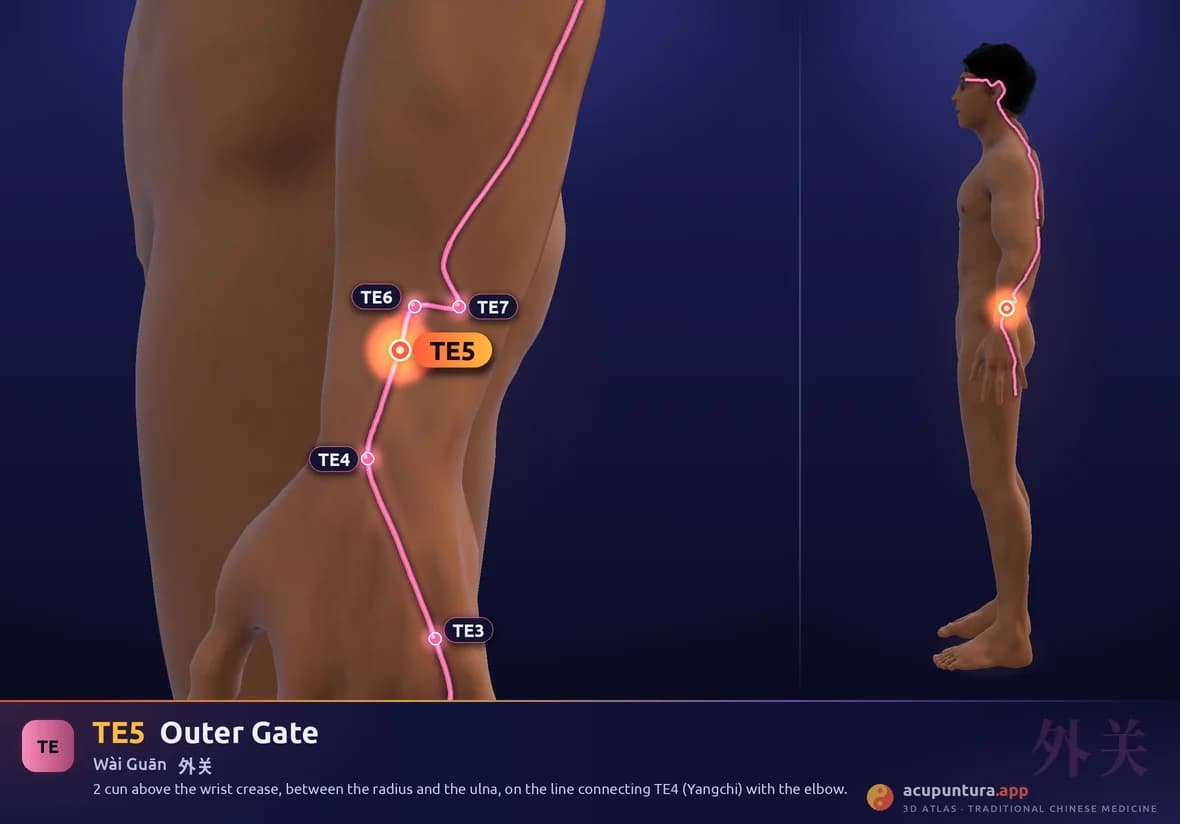
2 cun above the wrist crease, between the radius and the ulna, on the line connecting TE4 (Yangchi) with the elbow.
Main function
Luo-Connecting point, Opening point of the Yang Wei Mai, benefits the ears, relieves pain, releases the exterior.
- Luo (Connecting) point
- Opening point of the Yang Wei Mai
Therapeutic indications
- Headache
- ear pain
- deafness
- toothache
- arm pain
- fever
- common cold
- stiff neck
- Cold with fever
- Temporal headache
- Migraine
- Tinnitus
- Rib-side pain
- Wrist and forearm pain
- Hemiplegia
- Hand tremor
- Constipation
- Trigeminal neuralgia
- Tension headache
- Rheumatoid arthritis
Name and classical tradition
Waiguan, 外关, is the «outer barrier». 外 is the external, as opposed to 內, the internal; 关 (關), the pass, the barrier. The name is understood in tandem with that of PC6, Neiguan, the «inner barrier», which lies directly opposite, on the inner side of the forearm, at the same level. Both are Luo-Connecting points (絡穴) of coupled channels, the Triple Energizer and the Pericardium, and they connect through the arm.
As a Luo-Connecting point, Waiguan is attributed to the Lingshu (Spiritual Pivot), to the Jing Mai chapter (經脈), the one that lists the collaterals, although the passage has not been verified. It is also one of the Eight Confluent Points (八脈交會穴), the one associated with the Yang Wei Mai. One reading of the name starts from there: the Yang Wei Mai governs the cold and heat symptoms of the exterior of the body, and the point would be the barrier of the exterior. The other is simpler: the point is on the outer side of the forearm, at a place of passage. Both are consistent with its function.