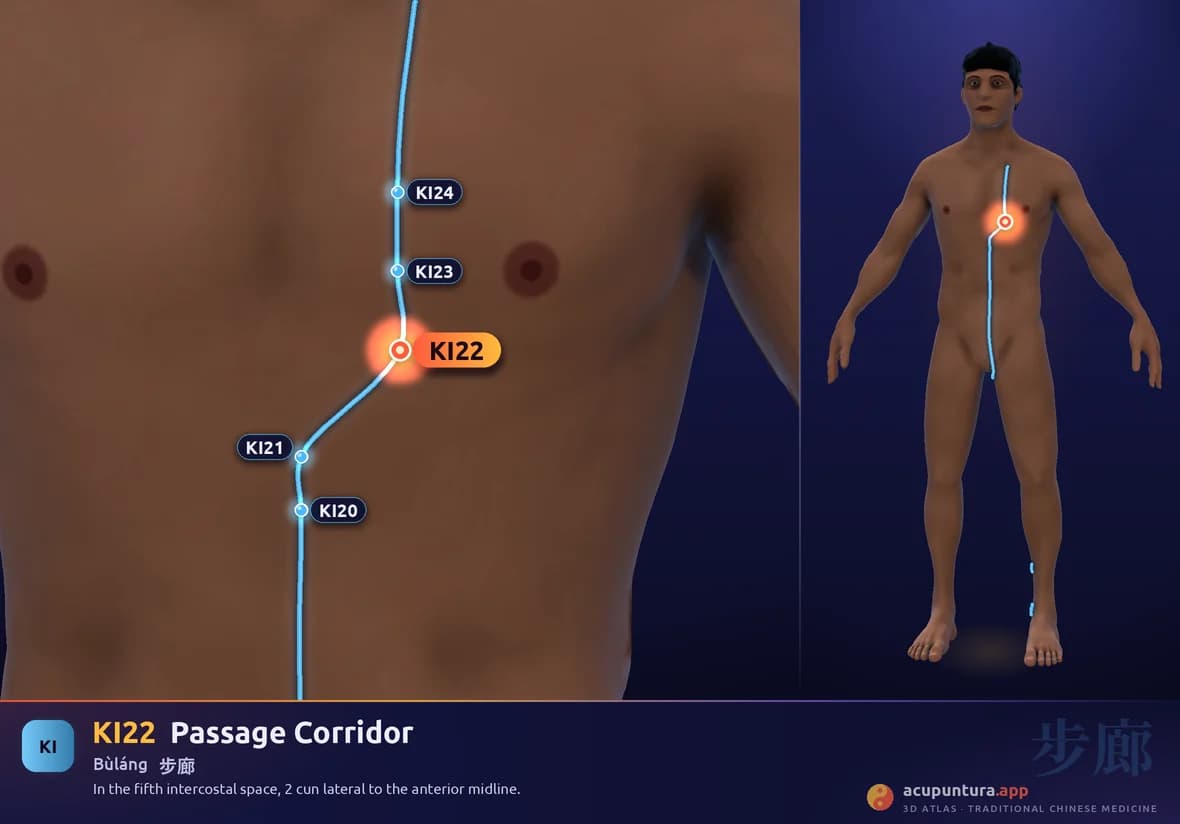
Kidney Channel
Passage Corridor
步廊BùlángAnatomical location
In the fifth intercostal space, 2 cun lateral to the anterior midline.
Main function
Regulates Kidney Qi, benefits the chest, and treats respiratory and thoracic disorders.
- Crossing point with the Lung
Therapeutic indications
- Cough
- asthma
- chest pain
- anxiety
- nausea
- vomiting
- poor appetite
- mastitis
Name and classical tradition
Bulang, 步廊, is the "corridor one walks along." 步 is the step, to walk; 廊 is the corridor, the gallery. Here the Kidney channel enters the chest, at the fifth intercostal space, and the points that follow come one per space, like the steps of someone walking down a gallery. The modern gloss explains it as Qi that rises and transforms into wind, with no classical citation.
The sources attribute it to the Zhenjiu Jiayi Jing (Systematic Classic of Acupuncture and Moxibustion). Sun Simiao's Qianjin Yaofang writes it as 步郎, a graphic variant. From here the channel climbs the chest two cun from the midline, with KI23, KI24, KI25, KI26, and KI27, and three of them carry names of the spirit.