ST39

Stomach Channel

Lower Great Hollow

下巨虚Xià Jù Xū

Anatomical location

9 cun below ST35 (Dubi) and 3 cun below ST37, one finger-width lateral to the anterior crest of the tibia.

Main function

Regulates the Small Intestine, eliminates Damp-Heat, relieves abdominal pain.

  • Lower He-Sea point of the Small Intestine

Therapeutic indications

  • Abdominal pain
  • diarrhea
  • dysentery
  • knee pain
  • testicular pain
  • lower abdominal pain
  • mastitis
  • leg pain and paralysis
  • low back pain radiating to the testicle

Name and classical tradition

Xiajuxu, 下巨虚, is the “lower great void,” the counterpart of ST37: the same broad hollow between the tibia and fibula, closer to the ankle. Like its partner, it had another name in the Lingshu (Spiritual Pivot): 巨虛下廉, “lower edge of the great void.” That old name brings it close to LI8, Xialian, the “lower edge” of the arm, a different point with which it should not be confused.

The Lingshu, in the chapter Xie Qi Zang Fu Bing Xing (邪氣臟腑病形), establishes it as the Lower He-Sea point (下合穴) of the Small Intestine: «小腸合入于巨虛下廉», the Small Intestine unites at the lower edge of the great void. In the chapter Si Shi Qi (四時氣), the same Lingshu states the principle that gives this function its meaning: «邪在府,取之合», when the disorder is in a Fu organ, treat it through its He-Sea point. Thus, the Stomach channel on the leg houses the meeting points of the two intestines, one above the other.
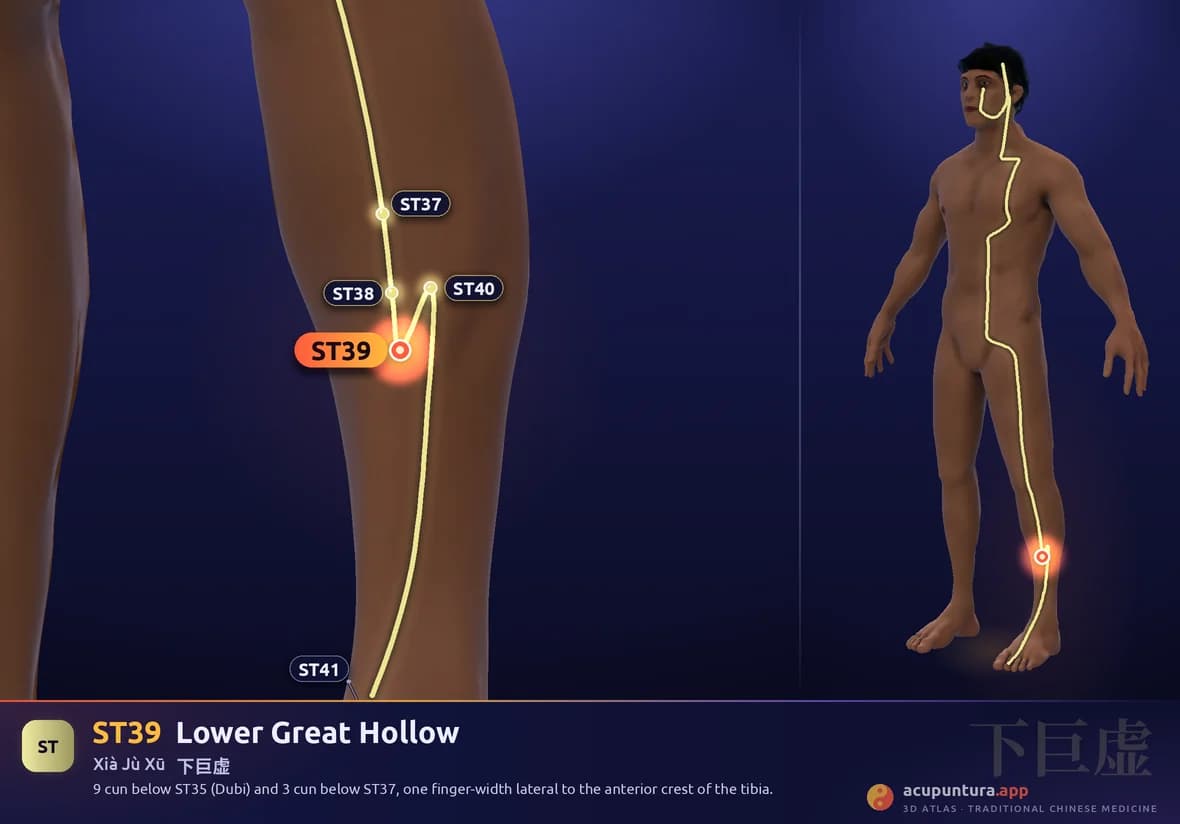

Location of point ST39, Lower Great Hollow
CC BY-ND 4.0 (opens in a new tab)
View point on the 3D modelST39 on the anatomy
Needling techniquePerpendicular insertion 1-1.5 cun or oblique toward the ankle.
Depth1-1.5 cun
MoxibustionApplicable (5-10 minutes, indirect moxa)

Basic formulas from the vademecum · 2

View the vademecum

Named functional sets from the school: here the point does not act on its own, but through the role it plays within the maneuver.

  • Descend the YangPregnancyBrings down the Yang that has stayed above, using the lower He-Sea points of the Large Intestine (ST37) and the Small Intestine (ST39) together with their Mu points (ST25) and the anchor of the lower abdomen (CV4).
  • Tonify the Triple EnergizerTreats the TE both as an organ and as a pathway: BL22 is its Back-Shu point and BL39 its lower He-Sea point; ST36, ST37, and ST39 are the lower He-Sea points of the three abdominal organs; TE3 and TE6 open the channel itself.
Cover of the guide “Protocols for the 20 most common patterns”

Free guide · PDF

Protocols for the 20 patterns you see most in practice

Each pattern with its tongue, its pulse, the treatment principle and the points to tonify and disperse. Made for the treatment table, not the bookshelf.

Do you use ST39 with your patients?

In the Clinic you record it in the patient's file, next to the tongue, the pulse and the measurements, so at the next session you know exactly what you used. The Atlas is built in.

See the Clinic