Bladder Channel
Kidney Shu
肾俞Shèn ShūUse caution during pregnancy
Back-Shu point of the Kidney, lumbar band. Useful for supporting the Jing, but with a gentle technique and without dispersion.
Anatomical location
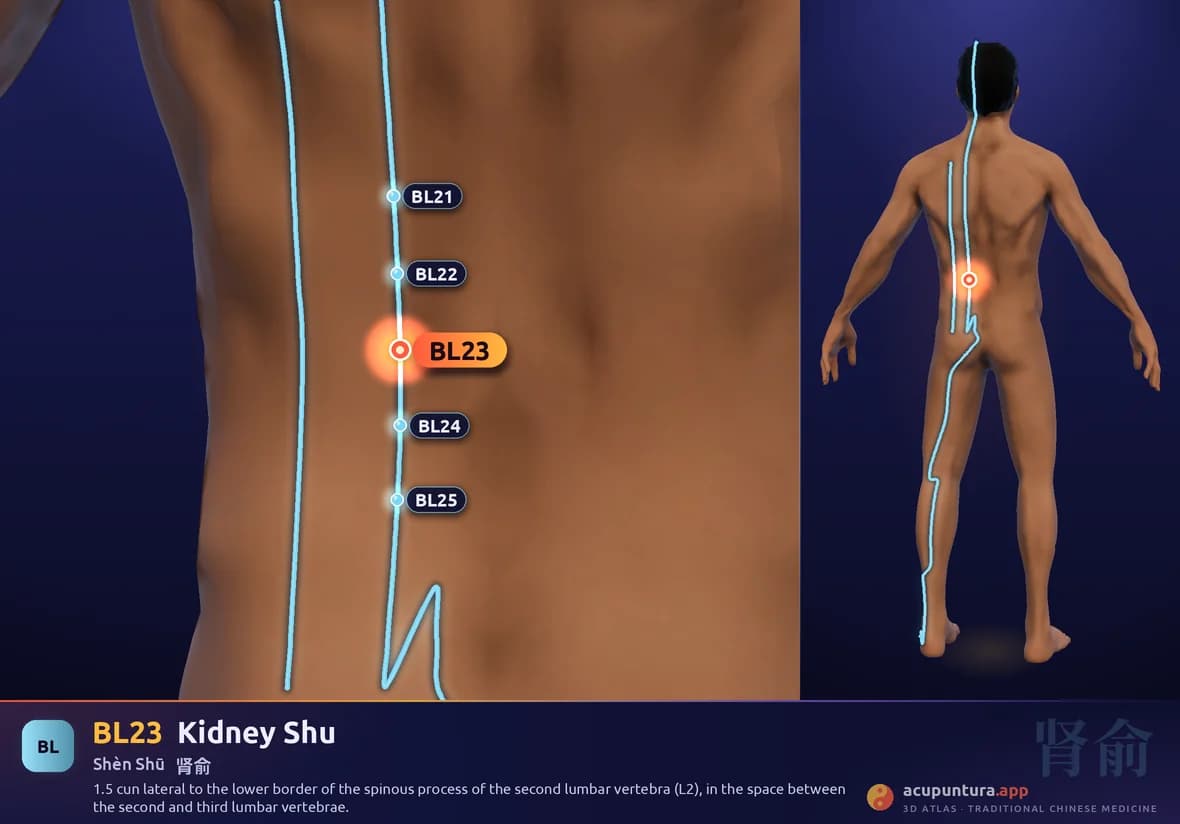
1.5 cun lateral to the lower border of the spinous process of the second lumbar vertebra (L2), in the space between the second and third lumbar vertebrae.
Main function
Strengthens the Kidney, nourishes Essence (Jing), benefits the marrow, strengthens the bones, regulates Water, benefits the ears, strengthens the lumbar region and the knees, nourishes Kidney Yin and Yang.
- Back-Shu point of the Kidney
Therapeutic indications
- Lumbago
- weak knees
- back pain
- tinnitus
- deafness
- hearing loss
- enuresis
- dysuria
- urinary retention
- edema
- impotence
- sterility
- irregular menstruation
- leukorrhea
- spermatorrhea
- premature ejaculation
- female infertility
- asthma
- cough
- dyspnea
- general weakness
- chronic fatigue
- premature aging
- premature gray hair
- memory loss
- dizziness
- vertigo
- night sweats
- afternoon fever
- pain in the lumbar spine
- sciatica
- Low back pain
- Nocturnal emission
- Menstrual irregularity
- Urinary frequency
- Chronic asthma
- Exhaustion
- Cognitive decline and dementia
- Parkinson's disease (tremor due to Internal Wind)
- Multiple sclerosis (Wei syndrome)
- Diabetes mellitus (Xiao Ke)
- Hypothyroidism
- Kidney stones and renal colic
- COPD and chronic bronchitis
- Polycystic ovary syndrome
- Lumbar disc herniation
- Ankylosing spondylitis
- Osteoporosis
- Alopecia areata
- Chemotherapy-induced leukopenia
- Anemia
Name and classical tradition
Shenshu, 肾俞, is the Back-Shu point of the Kidney. 肾 (腎) is the kidney; 俞 is the transport point. It is one of the best-attested Shu points. The Lingshu (Spiritual Pivot), in the chapter Bei Shu (背腧), closes its list of the Shu points of the organs with it: «腎腧在十四焦之間», the Shu of the Kidney lies in the space of the fourteenth vertebra. In the chapter Wei Qi (衛氣), the Lingshu also says of the Foot Shaoyin that its visible branch is «在背俞與舌下兩脈也», at the Back-Shu point and in the two vessels under the tongue. The Zhenjiu Jiayi Jing (Systematic Classic of Acupuncture and Moxibustion) places it «在第十四椎下兩傍各一寸五分».
With BL13, BL15, BL18, and BL20, it completes the five Shu points of the organs listed in the Bei Shu. Beside it, on the outer line, is BL52, Zhishi, the «chamber of the zhi», the will that the Lingshu links with the Kidney.