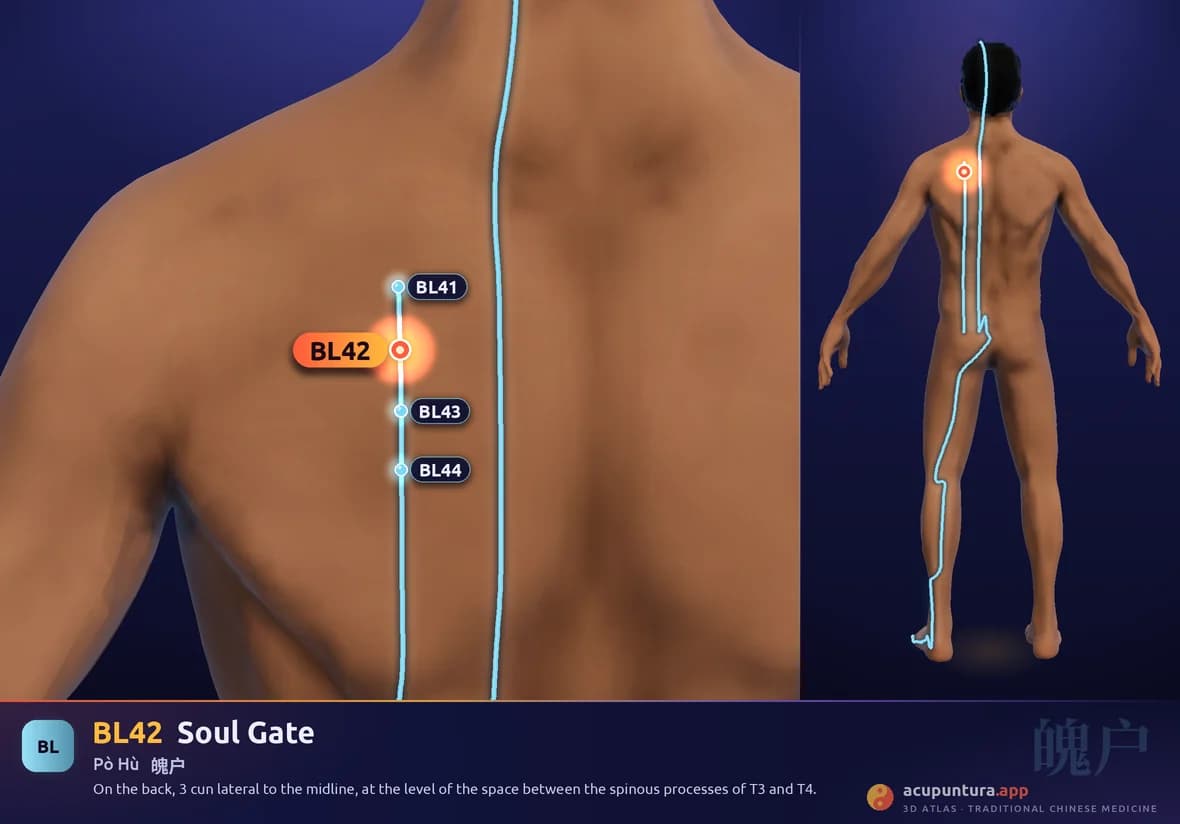
Bladder Channel
Soul Gate
魄户Pò HùAnatomical location
On the back, 3 cun lateral to the midline, at the level of the space between the spinous processes of T3 and T4.
Main function
Strengthens the Lung, regulates Qi, calms the Po (Corporeal Soul), relieves chest pain.
- Point of the Po (Corporeal Soul)
Therapeutic indications
- Cough
- asthma
- chest pain
- back pain
- neck stiffness
- hemoptysis
- nape stiffness
- shoulder and back pain
- pulmonary tuberculosis
Name and classical tradition
Pohu, 魄户, is the “door of the Po.” 魄, the Po, is one of the soul faculties that Chinese medicine distributes among the organs: the corporeal soul, the one bound to the body and to the Essence (Jing), which corresponds to the Lung; 户 (戶) is the door. The point sits on the outer line of the back, level with BL13, the Back-Shu point of the Lung, and opens a series of five points with soul-related names.
The foundation is in the Lingshu (Spiritual Pivot), in the Ben Shen (本神) chapter, which describes these faculties. Of the Po it says: “並精而出入者,謂之魄”, that which comes and goes together with the Essence is called the Po. The same chapter also associates the Po with the Lung, “肺藏氣,氣舍魄”: the Lung stores Qi, and Qi houses the Po.
The full series runs along the second line of the back: Pohu for the Po of the Lung, BL44 for the Shen of the Heart, BL47 for the Hun of the Liver, BL49 for the Yi of the Spleen, and BL52 for the Zhi of the Kidney. Each sits beside the Back-Shu point of its organ. It is one of the most coherent naming patterns in the entire system.