Spleen Channel
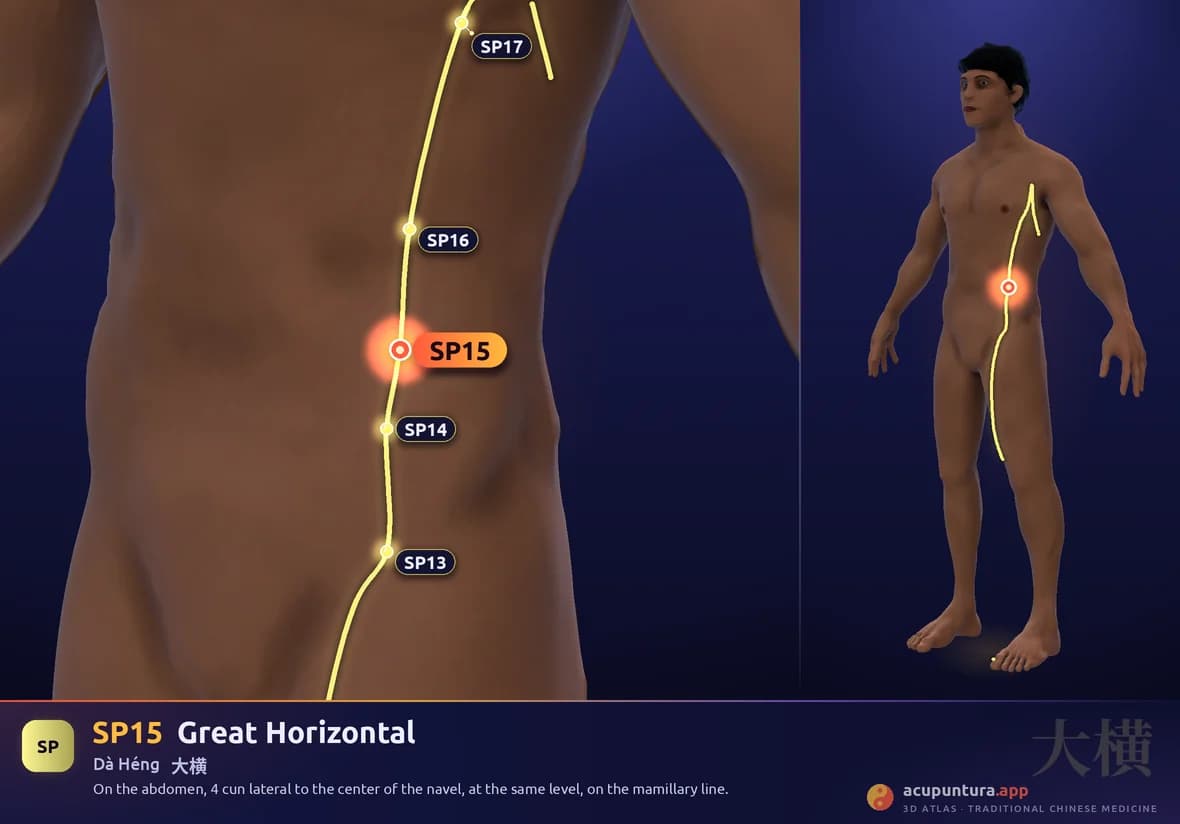
Great Horizontal
大横Dà HéngUse caution during pregnancy
Abdominal flank at the level of the navel; shallow needling.
Anatomical location
On the abdomen, 4 cun lateral to the center of the navel, at the same level, on the mamillary line.
Main function
Strengthens the Spleen and resolves Dampness, regulates the intestines and Qi, relieves pain.
- Crossing point with the Chong Mai
Therapeutic indications
- Abdominal pain and distension
- diarrhea
- dysentery
- constipation
- general fatigue
- abdominal pain
- heaviness of the body
- sadness
Name and classical tradition
Daheng, 大横, is the “Great Horizontal.” 大 means large or broad; 横 (橫) means horizontal or transverse. Modern textbooks explain it by the movement of Qi, which at this point would travel horizontally rather than up or down. The point lies at the level of the navel, on a transverse line, and that position is perhaps the simplest reading, although no ancient source states it.
The Zhenjiu Jiayi Jing (Systematic Classic of Acupuncture and Moxibustion) gives it an entry in the work’s characteristic formula: “大橫,在腹哀下三寸,直脐旁,足太陰、陰維之會。刺入七分,灸五壯”. Daheng is three cun below Fuai, level with the navel, beside it; it is the meeting point of the foot Taiyin and the Yin Wei Mai. Needle to a depth of seven fen and apply five cones of moxa. The quotation comes from a secondary source and should be checked.
It has two alternative names, 人横 and 肾气. The latter has no connection with the general concept of Kidney Qi or with the points of that channel: it is only an alias for this Spleen point.