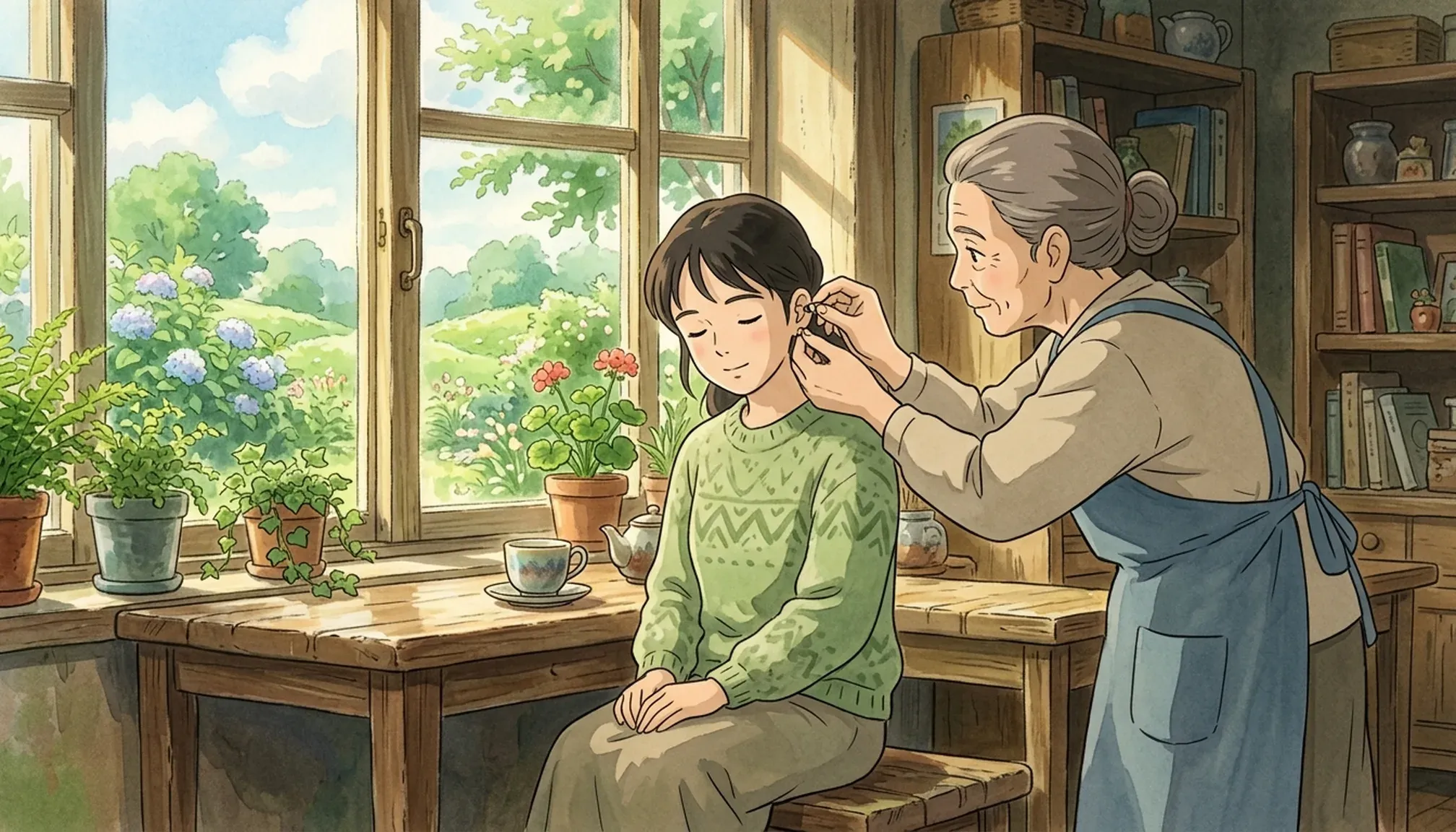
Auricular therapy for anxiety is one of the most discreet forms of acupuncture: instead of lying down with needles placed all over your body, the treatment focuses on one small area, the ear. You may have seen someone with a tiny seed taped to the outer ear and wondered whether that can really help when nerves keep you up at night, your chest feels tight, or your mind won't stop spinning. It's a fair question, and it deserves an answer without exaggeration.
In this article we explain why the ear is used, which points are most commonly chosen, how needles differ from seeds, how long the effect usually lasts, and what the research says. We also tell you when it's best to see a mental health professional, because auricular therapy can support you but does not replace medical or psychological care.
Why is anxiety treated through the ear?
Auricular therapy starts from a simple idea: the outer ear works as a small map of the body. According to this technique, each area of the ear corresponds to a region or organ, and stimulating it can have an effect at a distance. The image often used is that of an upside-down fetus: the earlobe would represent the head, and the top of the ear, the feet. It's a useful model for finding your way around, not a literal anatomical description.
From the perspective of Traditional Chinese Medicine (TCM), the ear is not isolated from the rest of the body. The channels, through which, in this tradition, Qi, or vital energy, circulates, connect to it, which is why it is considered a doorway to the whole body. When it comes to anxiety, TCM speaks of a Shen (the spirit or mind) that becomes agitated when the Heart is not at peace or when Qi stagnates because of prolonged stress. Auricular therapy aims to calm that agitation by stimulating specific areas of the ear.
The Western view offers a complementary explanation, though it is still hypothetical. The ear is richly innervated, with branches from several nerves, including some linked to the autonomic nervous system, which regulates heart rate, breathing, and digestion without our having to think about it. Researchers are exploring whether stimulating this area can help shift the body from alert mode to rest mode. It's an interesting line of work, but not settled fact.
There is another practical reason for its popularity: it's a gentle approach, quick to apply, and it hardly requires undressing or lying down for long. That makes it appealing if you feel uneasy about needles or are short on time.
Which ear points are used for anxiety?
There is no single recipe. A qualified practitioner chooses the points based on your situation: how you sleep, whether you notice palpitations, whether the anxiety comes with neck tension or digestive discomfort. Even so, a few ear points for anxiety come up again and again in practice:
Shenmen. Its name means "spirit gate," and it is probably the best-known point in auricular therapy. It is located in the upper part of the ear, in the triangular fossa. It is used to calm the mind, ease agitation, and generally encourage relaxation. Be careful not to confuse it with another point: there is also a body point with the same name on the wrist, Shenmen (HT7), which belongs to the Heart channel. They share a name and a general purpose, but they are different points.
Nervous system or autonomic point. It is used to help regulate the autonomic nervous system, the one involved when we feel a racing heart or a knot in the stomach.
Anxiety point. Some auricular maps include a specific area with this name. Its exact location can vary a little depending on the school, so it's up to the practitioner to confirm it on your ear.
Heart, Liver, and Kidney. In TCM, the Heart houses the Shen, the Liver is related to stress and pent-up frustration, and the Kidney to fear and exhaustion. That is why they are often combined with the points above.
It's worth stressing that you shouldn't press these points blindly yourself. The ear has a lot of detail in a small space, and a misread map is of little use. What you can safely do at home is give the whole outer ear a gentle massage between your thumb and index finger, from top to bottom, for one or two minutes: it feels pleasant and helps release tension.
Auricular therapy for stress and for nerves: is it the same as for anxiety?
Many people search for auricular therapy for stress or auricular therapy for nerves without having a diagnosis of anxiety. These are everyday terms for similar situations: sustained tension, irritability, light sleep, a feeling of always running on empty.
The technique and the points are largely the same, because the goal is identical: to lower the body's level of activation. What changes is the context. When the discomfort is passing stress from a rough patch at work or an exam, treatment can be brief and have a modest goal, such as sleeping a little better or feeling less tense. When we are talking about anxiety that lasts for months, medical and psychological assessment carries much more weight, and auricular therapy becomes a complement within a broader plan.
Needles or seeds on the ear: two ways to stimulate the same points
There are several ways to apply the technique, and the choice depends on your comfort and your practitioner's judgment.
Auricular needles
These are very fine, sterile, single-use needles that are placed on the chosen points and left in for about twenty to thirty minutes while you rest. The ear is a sensitive area, so insertion can feel sharper than elsewhere on the body, although it lasts only an instant. There are also tiny press needles that stay in place for a few days under a small dressing. They should only be used by a trained practitioner, and the area needs care to avoid irritation or infection.
Ear seeds for anxiety
Ear seeds for anxiety are the needle-free option. They are attached to the chosen point with a small piece of adhesive tape and left in place for several days. They are usually plant seeds, although metal or ceramic beads are also used. Your part is to press them gently, following a set routine, a few times a day, especially when you feel restlessness rising. The pressure should be firm but tolerable, never painful.
It's an especially convenient alternative for people who are afraid of needles, for those who want some stimulation between sessions, and, with a practitioner's approval, for some children and older adults. On the other hand, you need to keep an eye on your skin: if you develop intense redness, persistent itching, a sore, or oozing, remove the seed and seek advice. Keep in mind, too, that the adhesive tape can cause an allergic reaction in some people.
How long does the effect last, and how many sessions are needed?
This is the most honest question you can ask, and the answer is that it depends. There is no number that is right for everyone, and you should be wary of anyone who promises you an exact number of sessions or a guaranteed result in advance.
According to many people, this is what tends to happen:
After a session with needles, some people notice a sense of calm or lightness that can last for hours or a few days; others barely notice any change at first.
With seeds, the stimulation continues for as long as they stay in place, but the effect people perceive varies a great deal from person to person.
Recent anxiety tied to a specific situation tends to respond differently from anxiety that has been there for years.
The usual approach is to propose an initial series of sessions, weekly or a little more spread out, and then reassess. If you notice no benefit after a reasonable number of sessions, the most sensible thing is to review the approach rather than keep going indefinitely. Lifestyle changes, such as keeping regular sleep hours, moving every day, or taking breathing breaks, reinforce any treatment and are worth keeping up.
What does the evidence say about auricular therapy for relieving anxiety?
Here we need to be cautious. There is research on ear stimulation for anxiety and stress, and some studies describe improvements in feelings of calm or in sleep. However, the studies tend to be small and of uneven quality, and it is hard to separate the specific effect of the technique from that of other factors, such as time set aside to rest, the attention received, or participants' expectations. For that reason, the most honest assessment today is that the results are promising in some cases, but still limited and inconclusive.
This means several things for you. Auricular therapy can be a reasonable complement if you find it pleasant and receive it from a qualified practitioner, but it should not take the place of treatments with stronger support, such as psychotherapy or, when your doctor recommends it, medication. Nor is there solid evidence that it can resolve severe anxiety on its own.
Auricular therapy for anxiety and depression: what to know
Anxiety and low mood often appear together, which is why many people search for auricular therapy for anxiety and depression. The technique is sometimes used as a support in these conditions, and some people report feeling a little calmer or sleeping better. But depression is a health condition that requires medical assessment and its own treatment plan. Auricular therapy does not replace that, and it should not lead you to put off seeing a doctor. If you have had a very low mood for weeks, have lost interest in things you used to enjoy, or have thoughts of harming yourself, seek medical help as soon as possible.
When to see a mental health professional
Auricular therapy is a support, not a starting point for anxiety that is overwhelming you. See your doctor or a mental health professional if:
- The anxiety is intense, lasts for weeks, or interferes with your work, your studies, or your relationships.
- You have panic attacks, with a feeling of suffocation, intense palpitations, or fear of losing control.
- You avoid everyday situations for fear of feeling unwell.
- You notice a persistently low mood, hopelessness, or thoughts of harming yourself. In that case, seek immediate help: call emergency services or the suicide prevention hotline in your country.
- You take medication for anxiety and want to change it or stop it. Never do so on your own.
- New physical symptoms appear, such as chest pain or fainting, that need to be checked to rule out other causes.
If you are pregnant, take anticoagulants, have a pacemaker, or are going to treat a child, always tell the practitioner before starting, because the technique may need to be adapted or certain points avoided.
Frequently asked questions
Does auricular therapy for anxiety hurt?
It usually bothers very little. With needles, the ear can feel more sensitive than other areas, but the discomfort lasts a few seconds. With seeds there is no insertion, just pressure that should be tolerable. If you feel real pain, tell the practitioner or remove the seed.
How long are the seeds left on the ear?
They are usually left in place for a few days, as your practitioner indicates, and you press them several times a day. Try not to get them too wet, and remove them if your skin becomes irritated. Don't leave them on longer than recommended, and don't place them yourself without having received instructions.
Does auricular therapy help relieve everyday stress?
Many people use it for that purpose and report a feeling of calm. The research, however, is still limited. It can be a good complement if you find it pleasant, alongside habits such as slow breathing, sleeping regularly, and moving every day.
Can I combine auricular therapy with my medication or with psychotherapy?
In general, it's compatible, but let all the professionals who care for you know. Don't stop or change your medication on your own. When well coordinated, it can support psychotherapy as one more form of help, never as a substitute.
Who shouldn't have auricular therapy?
It's best to check first if you are pregnant, take anticoagulants, have a pacemaker, have skin problems on the ear or an active infection, or if the patient is a child. The same goes if you are prone to allergies to adhesive tape. The practitioner will assess whether it is suitable and how to adapt it.
In short: gentle help, with your feet on the ground
Auricular therapy for anxiety offers a delicate, accessible way to stimulate points such as Shenmen, the nervous system, or the anxiety area, whether with needles or with seeds. Many people experience it as a moment of calm, and in TCM it follows a coherent logic. But the evidence is still limited, results vary from person to person, and no one can promise you a specific outcome. Use it as a complement, with a qualified practitioner, without giving up medical diagnosis or psychological support when you need them. Looking after your calm takes several tools at once.