Have you ever noticed that when you worry too much your stomach ties itself in a knot, or that anger seems to rise right up into your neck? These reactions are no coincidence. For thousands of years, Traditional Chinese Medicine (TCM) has held that emotions and physical health go hand in hand, and that suppressing what we feel eventually takes a toll on the body. In this article we explain, in plain terms, how Chinese medicine understands emotions, how too much worry, anger, sadness, fear, or even overflowing joy shows up in your daily life, and which simple tools you can use to express what you feel and look after your well-being.
The Chinese view: body and mind are not separate
In our culture we tend to separate the physical from the emotional, as if headaches, fatigue, or poor digestion were purely "body problems." Chinese medicine has never made that division.
In Traditional Chinese Medicine, the body and the emotions form a single system. The vital force that animates us, which the Chinese call Qi (pronounced "chee" and often translated as energy), circulates throughout our whole body. When Qi flows harmoniously, we feel well on every level. But when an emotion becomes intense or is held back for a long time, that flow is disrupted and physical discomfort begins to appear.
That is why, in TCM, the question is not only "Where does it hurt?" but also "How is this person doing? How do they sleep, eat, and live? What is weighing on their life?" Two people can have the same symptom for very different emotional reasons, and Chinese medicine holds that treatment should take the whole picture into account.
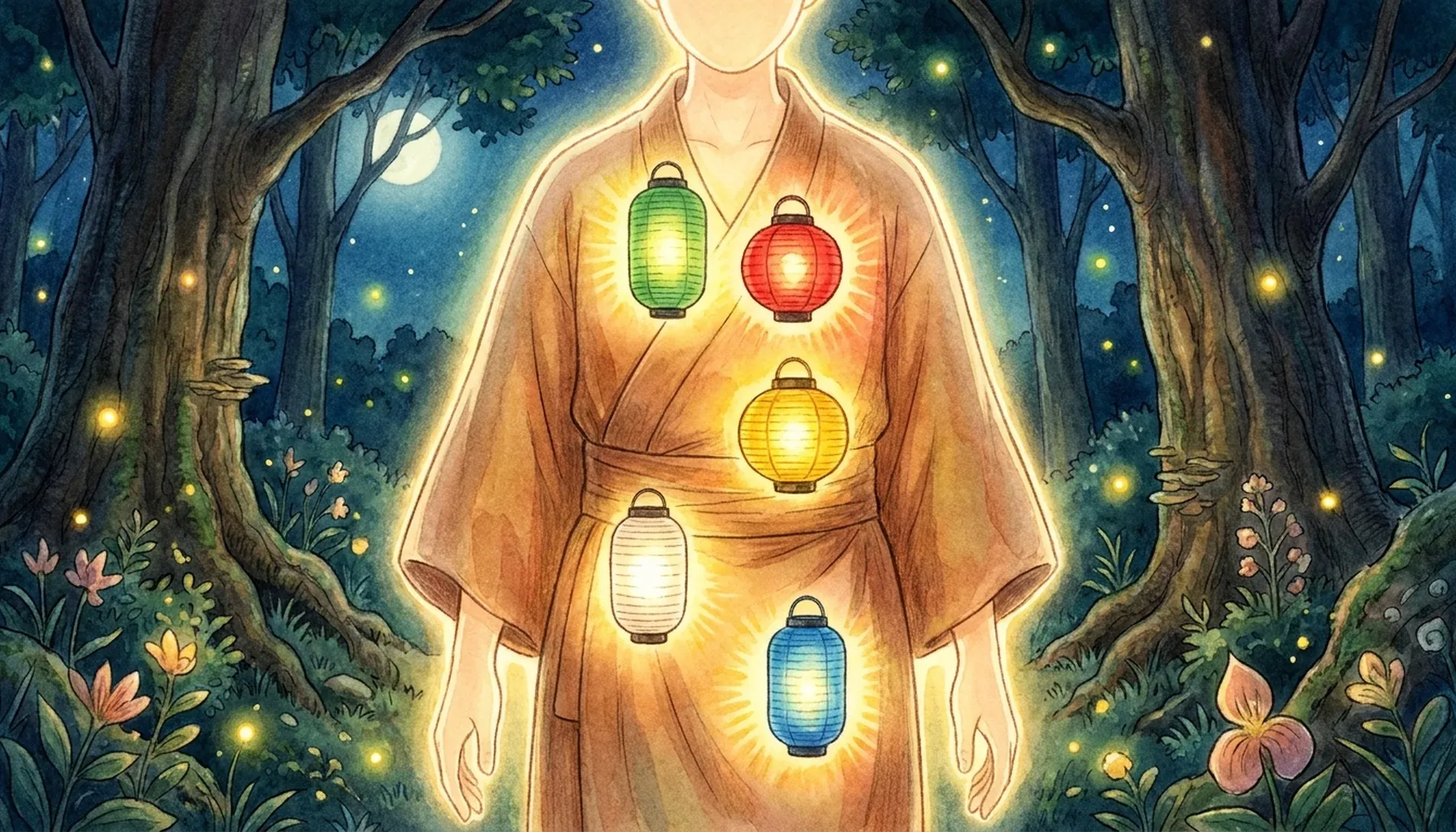
The five emotions and the body
According to the Chinese tradition, each main emotion is associated with an organ and with certain common physical patterns. It is not that the emotion directly "damages" the organ; rather, an emotional experience that is repeated or very intense can show up in particular areas of the body. We'll walk you through it in general terms, without technical jargon.
Worry and overthinking: the mental loop you feel in your stomach
Excessive worry is perhaps the most widespread emotion of our time. Thinking in loops, going over the same thing again and again, anticipating problems that haven't happened yet.
In the Chinese view, this constant overthinking is felt mainly in the stomach and abdomen: think of that "knot" sensation, the loss of appetite when you're anxious, or the heavy digestion after weeks of stress. When the mind spins without stopping, the body gets "stuck" in that same spin.
Everyday signs of excessive worry:
Slow or heavy digestion, especially during periods of heavy mental load.
Repetitive thoughts that keep you from concentrating or resting.
Fatigue after eating, as if the food weighed twice as much.
A general feeling of heaviness, of a worn-out body when stress becomes chronic.
Anger: when rage rises
Anger is not bad in itself: it is a legitimate emotion that alerts us to injustice or crossed boundaries. The problem appears when it is systematically suppressed or when it erupts too often.
In everyday language we already say it: "my blood is boiling," "I'm seeing red," "I woke up on the wrong side of the bed." Chinese medicine associates this emotion above all with the right side of the torso, the head, and the eyes. It is not unusual to get a headache after a very bad fit of anger, to have red eyes, or to notice tension in your neck and shoulders.
Common signs of poorly managed anger:
Headache or a feeling of heat in the face after arguments.
Tension in the jaw, neck, and shoulders (often without knowing why).
Frequent irritability, that "everything bothers me" state.
A habit of swallowing your anger, with all the accumulated tension that brings.
Sadness: the weight of what goes uncried
Sadness is part of life: grief, loss, goodbyes. The difficulty comes when we don't find room to live through it and keep it bottled up.
In Chinese medicine, suppressed sadness is related above all to the chest and the breath. Have you noticed that when you're feeling low you breathe more shallowly, as if your chest were getting narrower? That feeling of weight on the chest, or of sighing often, are very recognizable signs that there is accumulated emotion asking for a way out.
Signs of sadness that needs room:
Frequent sighing or short breathing with no physical cause.
A feeling of tightness in the chest during times of grief or loneliness.
Dull-looking skin and little motivation to take care of yourself.
Difficulty "filling your lungs" with air, especially when it gets worse with your mood.
Fear: the constant alert that wears you out
Fear is a perfectly useful survival response. But living with chronic fear (job insecurity, money problems, anticipatory anxiety) keeps the body on continuous alert.
The Chinese tradition associates prolonged fear with a feeling of deep exhaustion and with the lower back and legs. Think of how your legs "go weak" when we get a good scare. When fear becomes chronic, the feeling is one of emptiness, of not having the strength to get through everyday life.
Signs of entrenched fear:
Tiredness that sleep doesn't fix, as if the body were always "on guard."
A weak or cold lower back, low back discomfort during times of insecurity.
Frequent urination or urgency when you're very nervous.
Constant fear of the future, always anticipating the worst-case scenario.
Overflowing joy: yes, it can throw you off balance too
This often comes as a surprise: even joy is on this list? Chinese medicine doesn't say that being happy is bad, only that excess disturbs as well. Living constantly in "party mode," revved up, with your mind scattered across a thousand stimuli and no moments of calm, wears you down too.
Excessive or uncontrolled joy is related to the Heart and its rhythm: think of a racing heart, of sleeping little and badly from overexcitement, of that feeling of "never switching off." The balance TCM seeks is not sadness, but serenity: the ability to feel fully while also having a steady center.
What matters most: express, don't suppress
If there is one idea Chinese medicine defends clearly, it is this: emotions should not be swallowed. An emotion that is lived and expressed with respect flows and transforms; a suppressed emotion builds up and ends up looking for a way out through the body.
This doesn't mean unloading your anger on others or dramatizing everything we feel. It means giving yourself permission to recognize what is happening inside, name it, and find a healthy outlet. Well-channeled anger can become firmness; sadness that is well accompanied can become acceptance; fear that is well understood can become prudence.
Simple tools to care for your emotional world
For centuries, Chinese medicine has gathered accessible resources for maintaining emotional balance. Here are some practices you can add to your routine starting today:
Mindful breathing: spend five minutes a day breathing slowly, letting your belly expand as you inhale and soften as you exhale. When your mind is ruminating, slow breathing is one of the most direct ways to calm the nervous system.
Gentle movement: walking, tai chi, gentle yoga, or simply stretching. Movement releases the tension built up in the neck, shoulders, jaw, and back, the areas where we most often store emotions.
Writing down what you feel: five minutes with a notebook can sort out what your mind has tangled up. Nobody needs to read it; it's enough to let out what is inside.
Talking with someone you trust: sharing what weighs on you literally lightens the load. Asking for help is not weakness; it is a health tool.
Routines that anchor you: eating at regular times, going to bed early, and limiting screens before sleep give the body stability, and a stable body supports the emotions better.
Contact with nature: the changing seasons also affect our mood. In Chinese medicine, each season is linked to certain energies and emotions; adapting your pace of life to the natural calendar is a form of care in itself.
Acupuncture points for the emotions
In the treatment room, the acupuncturist chooses points according to the predominant emotion and the organ the tradition links it to. Here are some examples that come up often, and that you can also press with your fingers for a minute or two:
Anger, irritability, pent-up tension: Taichong (LR3), on the top of the foot, between the big toe and the second toe.
Worry and overthinking: Zusanli (ST36), below the knee, and Sanyinjiao (SP6), above the inner ankle.
Sadness and tightness in the chest: Danzhong (CV17), in the center of the chest, and Lieque (LU7), on the forearm next to the wrist.
Fear and exhaustion: Taixi (KI3), between the inner ankle and the Achilles tendon.
Restlessness, a racing mind, poor sleep: Shenmen (HT7), on the wrist crease, on the little-finger side. On the back there is even a row of points named after each of the faculties of the spirit: these are the points of the soul.
When what you have is emotional exhaustion that has lasted for months, the kind that leaves you with no desire to do anything, points alone help little: it's worth reviewing your workload and caregiving load, and talking it over with a professional. We cover this in depth in our article on burnout.
And what does science say about all this?
It is reasonable to approach all of this with interest and also with a critical eye. Current research in lifestyle medicine and psychoneuroimmunology points in an interesting direction: there is growing evidence that chronic stress and certain emotional patterns have measurable effects on the nervous system, digestion, sleep, and inflammation.
As for acupuncture, some studies suggest it may be useful as a complement in managing stress, anxiety, insomnia, or some physical symptoms associated with emotional states. The evidence is still limited in some areas, but the results are promising and active research is under way. The most honest way to put it is this: acupuncture is a good complement, not a substitute for psychological or medical care when it is needed.
When to see a doctor
Taking care of your emotions is important, but it does not replace health care. See your doctor or a mental health professional if:
- You feel persistent sadness, anxiety, or irritability for more than a few weeks and it keeps you from living normally.
- You have physical symptoms that don't improve (chest pain, shortness of breath, weight loss, chronic insomnia) or that worry you.
- You have thoughts of harming yourself or can't see a way out: in that case, seek help immediately. In Spain you can call 024 or 112.
- Your emotions interfere with your work, your relationships, or your self-care on an ongoing basis.
Acupuncture and Traditional Chinese Medicine can support you as a complement, but they should never delay a diagnosis or a medically necessary treatment.
Frequently asked questions
Does acupuncture help with stress and anxiety?
Some studies suggest that acupuncture can help reduce stress and improve the feeling of calm, acting as a complement to other measures such as breathing exercises, physical activity, or psychological therapy. The evidence is promising though still limited, and it works best as part of a comprehensive approach.
How many acupuncture sessions does it take to feel better?
It depends on the person and on what you want to work on. Many people notice changes in their general state after just a few sessions, while others need a longer process. It's common for the practitioner to propose an initial plan and adjust it based on how you respond.
Does acupuncture hurt?
In general, no. The needles are very thin, much thinner than those used for blood tests, and most people barely feel them or describe a sensation of heaviness, warmth, or mild tingling. If at any point it feels uncomfortable, you can always tell the practitioner.
Can acupuncture replace a psychologist or psychiatrist?
No. Acupuncture is a complement that can help you relax and find your balance, but if you have an emotional problem that significantly affects you, the best approach is to combine it with the support of a mental health professional and follow your doctor's guidance.
Is it normal to get emotional or cry during a session?
Yes, and it happens more often than people say. As the body relaxes, some people feel like crying, feel a sadness they weren't expecting, or, on the contrary, feel a great sense of relief. It's what many people describe as "releasing emotions." It isn't dangerous and doesn't mean anything is wrong; a good practitioner welcomes it naturally and gives you all the time you need. If it happens often, it may be a sign that you're carrying a lot inside and that you could use a space to talk about it, including with a psychologist.
Does it make sense to try acupuncture even if nothing hurts?
Yes. Many people come for prevention or to improve their general well-being: sleep, energy, digestion, or stress management. In Chinese medicine, working on balance before discomfort appears is understood to be one of the best investments in health.
Take care of your inner world, take care of your body
Emotions are not a decoration of life or a problem to hide: they are part of your health, and your body listens to all of them. Chinese medicine reminds us of something everyday life confirms every day: what we feel shows, and taking care of it is also taking care of yourself.
If you notice that stress, worry, or any other emotion is taking a toll on you, don't let it slide. Consult a qualified professional in acupuncture and Traditional Chinese Medicine, who can assess your case individually and propose a plan tailored to you, as a complement to your doctor's follow-up. Your body and mind will thank you.