If you've ever seen someone with a tiny seed taped to their ear, or read that ear acupuncture is used as support for stress or sleep, you've probably wondered two very practical things: which points are there on such a small surface, and above all, which of the two ears gets what. It's not a minor question, because hardly anyone knows whether the practitioner chooses the right ear, the left, or both, or by what criteria.
In this article we take the basics for granted, since we already covered them in what auricular therapy is, and go straight to what usually goes unanswered. You'll see how the auricular map is organized, what its main zones are in plain language, how the choice between the right and left ear is made, what the difference is between needles, seeds, and press tacks, and why it's a bad idea to improvise on your own.
The Ear as a Map of the Body: The Inverted Fetus
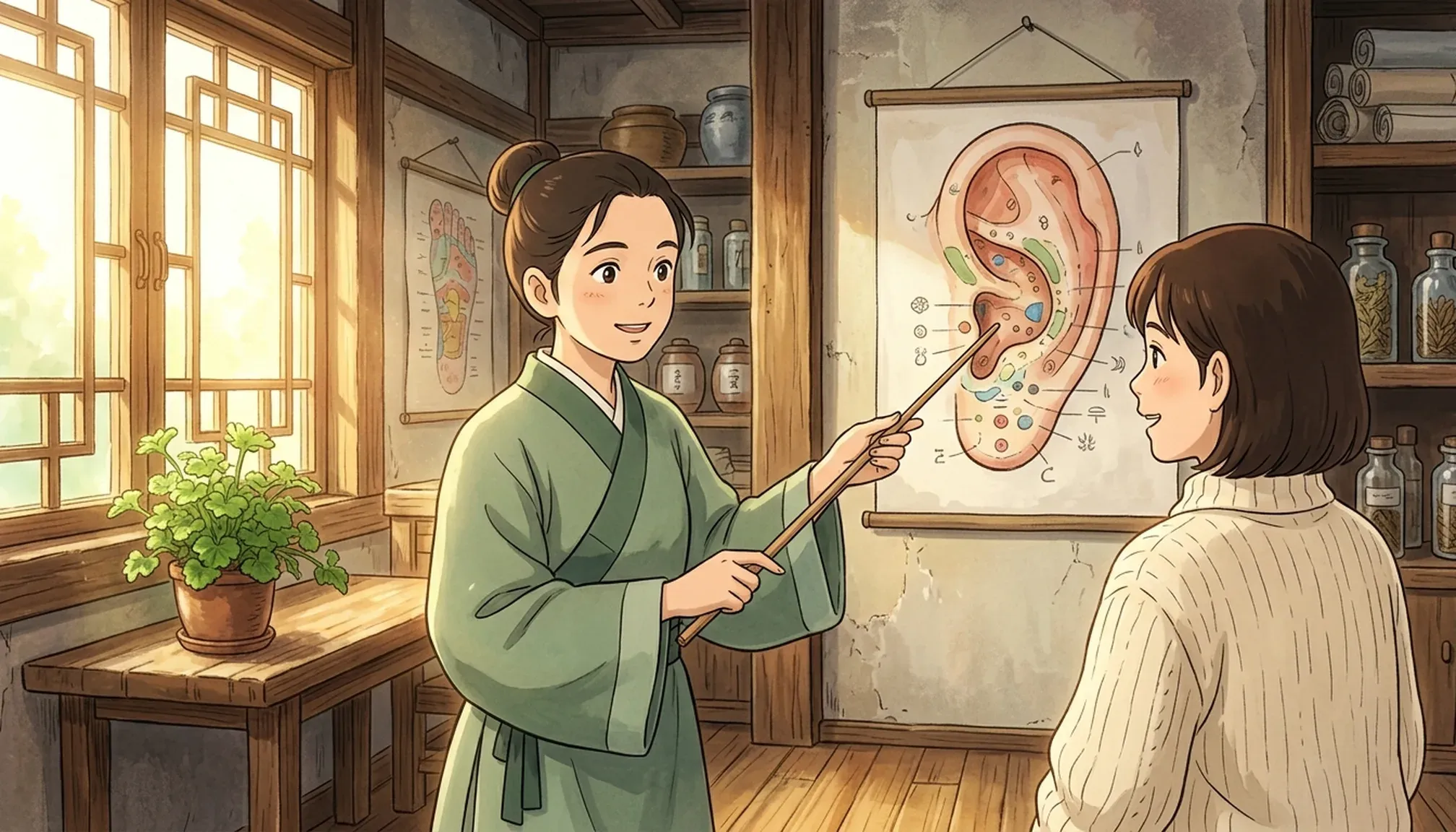
Auricular therapy sees the auricle, the outer, visible part of the ear, as a small-scale representation of the whole body. The image used to explain it is that of the inverted fetus: if you draw a baby curled up with its head down on the ear, the head sits on the earlobe, the spine runs along the inner curved edge, and the limbs lie toward the top.
It's a useful metaphor, not a literal anatomical blueprint. It helps you remember that the lower areas of the ear are associated with the head and face, the middle ones with the trunk and organs, and the upper ones with the limbs and spine. From the viewpoint of Chinese medicine, each zone acts as a small point of contact with a part of the body and with the energy channels. From a more Western perspective, it's usually explained that the ear has many nerve endings, which would help explain why stimulating it produces a feeling of relaxation in many people.
Keep in mind that there are several auricular maps. There's one from the French tradition, another with Chinese roots, and later proposals that tried to unify them, and they don't agree completely on every detail. That's why a practitioner relies on the auricular map they know well and, in addition, on what they find in your ear, something we'll look at below.
Acupuncture Points on the Ear: The Main Zones, Without the Jargon
Ear acupuncture points number in the dozens, but to understand the map you only need to know its major regions. They're described here as a general guide; the fine detail is always decided by whoever is treating you.
The earlobe. This is the zone of the head and face: it relates to the jaw, teeth, eyes, and the area of the mind. It's often involved when the goal is to ease facial or mental tension.
The antitragus and the tragus. The antitragus is the small bump across from the tragus, the flap that partly covers the ear canal. These zones are associated with the head, the nervous system, and certain aspects of appetite and anxiety.
The concha. This is the hollow cavity in the center of the ear, surrounding the entrance to the ear canal. On the map it represents the trunk and internal organs, with the abdomen and chest areas at different levels.
The antihelix. This is the curved, Y-shaped ridge that runs through the inside of the ear. It represents the spine and, in its upper branches, the legs and arms.
The triangular fossa and the scapha. These are the depressions in the upper part. They relate to the pelvic area, the limbs, and, depending on the map, to general calming points.
The helix. This is the rolled outer rim of the ear. Some commonly used points for general balance and a sense of calm are located there.
A frequently cited example is the point called Shenmen, which means "spirit gate" and is often used in auricular therapy for relaxation. Don't confuse it with the Shenmen on the wrist, a point on the Heart channel that you'll find in the Atlas as Shenmen (HT7): they share a name, but one is on the ear and the other on the inner side of the wrist, and they are different points. Auricular points are named by their location on the map and don't follow the same channel-based numbering as body points.
Acupuncture Point Map: What It Is and How It Differs from the Ear Map
An acupuncture point map is simply a graphic representation of the body showing where each point is and which channel it belongs to. In Chinese medicine, channels (meridians) are the pathways along which qi, the vital energy, is understood to flow, and each point is a specific place along that pathway where you can act with needles, pressure, or heat. That's why, when someone talks about "the map" without further qualification, they almost always mean the full-body one, with its colored lines running down the arms, legs, trunk, and head.
That general map works with a different logic from the auricular map. On the body, each point has a code made up of the abbreviation of its channel and a number indicating its position along the pathway. So Zú Sān Lǐ (ST36), "Leg Three Miles," is point number 36 on the Stomach channel, below the knee; Hé Gǔ (LI4), "Joining Valley," is the fourth on the Large Intestine channel, on the hand; and Bǎi Huì (GV20), "Hundred Meetings," sits at the top of the head, on the Governing Vessel. On the ear, by contrast, there are no pathways or channel-based numbering: the map is a kind of miniature of the body, and each zone takes its name from the part it represents.
Put another way, the body's acupuncture point map is read by following lines, while the ear's is read like a drawing. Both belong to the same tradition and a practitioner can combine them in a single session, but you shouldn't mix up their codes or assume that a body point has an exact copy on the ear.
How to Read an Ear Acupuncture Point Map
If you have a chart or poster of ear acupuncture points in front of you, the most useful thing is to start with the landmarks you can touch on your own ear: the lobe at the bottom, the concha in the center, the ridge of the antihelix, and the rim of the helix on the outside. Once you've located those big zones, the rest of the drawing makes sense thanks to the inverted fetus image we described earlier.
Also keep in mind that on charts the points appear as neatly separated circles, but on a real ear they're one or two millimeters apart, and their position varies a little with each person's size and shape. That's why an auricular map is useful for understanding auricular therapy and following what your therapist explains, not for locating exact points on your own. And remember that, depending on the school followed by whoever drew it, some zones may change position or name.
Auricular Therapy: Right Ear or Left Ear? How It's Decided
This is the question people search for most, and the honest answer is that there is no single, universal rule. Different schools and practitioners use different criteria, and all of them are reasonable within their own framework. The most common ones are these:
Which side the symptom is on. If the discomfort is clearly on one side of the body, for example tension in the right shoulder, the ear on the same side can be treated, or in some schools the opposite one. There is debate about which is better, and it shouldn't be considered settled.
Alternating between ears. In treatments with seeds or press tacks that stay on for several days, it's common to place one ear in one session and the other in the next. This gives the skin a rest, keeps it from always bothering you when you sleep on the same side, and spreads out the stimulation.
Both ears at once. When the reason for the visit isn't one-sided, such as stress, insomnia, or support for quitting smoking, many practitioners work both ears, either in the same session or alternating.
The most reactive ear. Some therapists examine the ear with a small probe or finger pressure and choose the one that shows more tenderness, redness, or skin changes in the zones related to your problem.
Your handedness. Some practitioners take into account whether you're right- or left-handed, or simply which of your ears is more comfortable for wearing the material.
In short, the question of right or left ear in auricular therapy has no closed answer: it depends on the school, your situation, and how your body responds. A sensible practitioner will explain why they choose one ear or both, and will adjust the decision from session to session if needed. The fact that two acupuncturists choose differently doesn't mean one of them is wrong.
Needles, Seeds, and Press Tacks: How the Points Are Stimulated
Once the points and the ear have been chosen, there are several ways to stimulate them. Each has its place and is chosen according to the goal, the expected duration, and your comfort.
Needles. They're very fine and inserted superficially, usually for a few minutes. They're used mainly in the office, with sterile, single-use equipment.
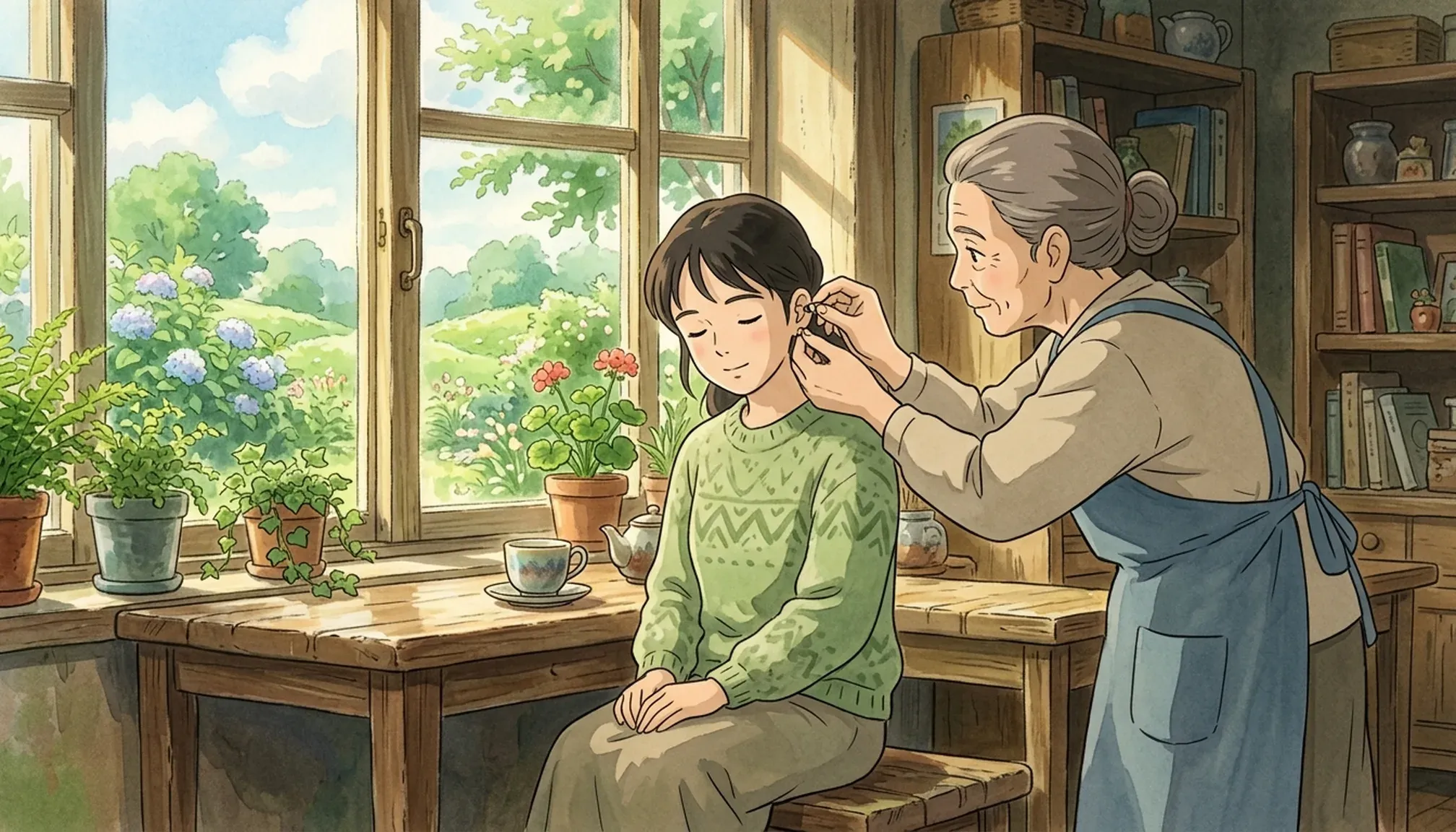
Seeds. These are small plant seeds, traditionally vaccaria seeds, held in place with a hypoallergenic adhesive. They don't pierce the skin: they press. They can be worn for a few days and are gently stimulated with a finger several times a day, as directed by the practitioner. They're a very well-accepted option for people who can't stand needles.
Press tacks. These are tiny, semi-permanent needles shaped like a small thumbtack, held in place with a patch for several days. They provide more continuous stimulation than seeds. Precisely for that reason they require more care with hygiene, and only a professional should place them.
There are also metal beads, magnets, and small adhesive pressure devices that work like seeds. Whatever the technique, they're normally removed after a few days, or sooner if discomfort, redness, or itching appears.
Why Shouldn't You Apply It to Yourself Without Guidance?
With the map in hand, it's tempting to try it yourself. Even so, there are good reasons not to, especially when it comes to needles or press tacks.
Maps don't fully agree. As we said, there are several versions, and pinpointing a spot within a zone a few millimeters wide takes practice.
Risk of infection. The cartilage of the ear has a poor blood supply, and if it's punctured without good hygiene or sterile equipment, an infection can be unpleasant and hard to clear up.
No prior assessment. Choosing points without knowing your history, your medication, or your circumstances, such as a pregnancy, can be counterproductive.
It can delay a necessary visit. If what's happening to you calls for medical attention, trying things on your own may cost you valuable time.
What you can do at home, with care, is a gentle ear massage: pinching and running your fingers along the rim, the lobe, and the concha for a minute or two is usually pleasant and relaxing. It's a general acupressure gesture, without looking for specific points or pressing hard. If you notice pain, irritation, or any change in the skin, stop and seek advice.
When to See a Professional or Talk to Your Doctor First
Ear acupuncture is a complementary practice: it accompanies medical diagnosis and treatment but doesn't replace it. Talk to your doctor or acupuncturist first in these cases:
- If you're pregnant or think you might be.
- If you take anticoagulants or have clotting problems.
- If you have a pacemaker or another implanted device.
- If there are wounds, infections, or irritation on the ear.
- If it's for a child, or for a person with a serious or chronic illness who is under treatment.
Frequently asked questions
Which ear is auricular therapy placed on?
It depends on the practitioner and your case. They may choose the ear on the side of the discomfort, alternate one ear each session, or work both at once. Some therapists pick the more sensitive one after examining it. There's no single rule, and what matters is that whoever treats you explains their criteria.
Are the points the same on both ears?
The auricular map is practically the same on both ears: each one is a complete representation of the body. What changes is which one is stimulated and in which zones, according to the practitioner's criteria and what they find when examining you. That's why it's common for a session not to place exactly the same thing on one ear as on the other.
What is an acupuncture point map?
It's a diagram of the body that shows where each acupuncture point is and which channel or meridian it belongs to. The general map runs across the whole body with lines and numbered points, while the auricular map represents the entire body within the ear. Both help you understand the technique, but locating points precisely requires training and practice.
Can an ear point map be used to do auricular therapy at home?
It helps you understand what the practitioner is doing and recognize the zones of your ear, but not to place needles or press tacks on yourself. The points are very close together, maps vary by school, and a puncture with non-sterile material can infect the cartilage. At home, the sensible thing is to limit yourself to a gentle massage of the whole ear.
Does ear acupuncture hurt?
Generally, no. With fine needles you may feel a slight, brief prick, and with seeds there's only gentle pressure. The ear is a sensitive area, so some people notice the contact more at certain points. If something is uncomfortable, say so, so the practitioner can adjust it or remove it.
How long are seeds or press tacks left in place?
It's usually a few days, until the next session, although the practitioner sets the timeframe and it varies with the material. They're removed sooner if pain, itching, redness, or discharge appears. It's best not to get them too wet and not to sleep pressing hard on the treated ear.
Can I sleep on the ear with seeds on it?
You can, although it's sometimes uncomfortable because the seed presses against the pillow. Many people manage by sleeping on the other side, and that's one of the reasons therapists alternate the treated ear. If the discomfort wakes you up or leaves a mark on your skin, remove the adhesive and mention it at your next visit.
Conclusion
The ear map, with its inverted fetus and its major zones, helps you understand how ear acupuncture links a tiny point to a part of the body. As for the right or left ear, there's no single answer: it's chosen according to the school, the symptom, and what the practitioner observes in you. If you'd like to try it, see a qualified professional who will assess your case, use appropriate materials, and work in coordination with your doctor. At home, stick to the gentle massage and leave the needles and press tacks to the experts.