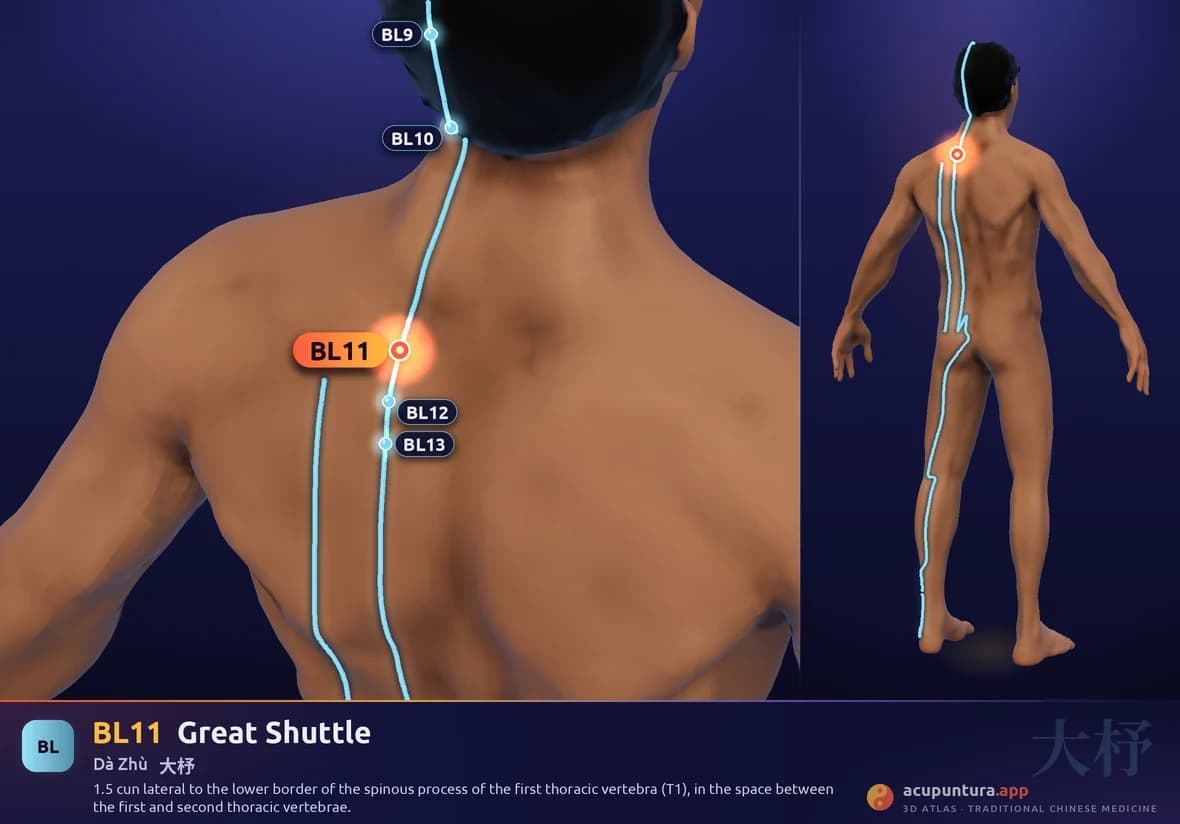
Bladder Channel
Great Shuttle
大杼Dà ZhùAnatomical location
1.5 cun lateral to the lower border of the spinous process of the first thoracic vertebra (T1), in the space between the first and second thoracic vertebrae.
Main function
Strengthens Wei Qi (Defensive Qi), regulates Lung Qi, benefits the bones and joints, relieves cough and asthma, calms back pain.
- Hui point of the Bones
- Sea of Blood Point
- Crossing point with the Small Intestine channel
Therapeutic indications
- Cough
- asthma
- sore throat
- fever
- back pain
- spinal stiffness
- shoulder pain
- neck pain
- headache
- stiff neck
- general fatigue
- weakness of the limbs
- arthralgia
- osteoporosis
- Shoulder and back pain
- Headache
- Joint disorders
- Bone weakness
- Ankylosing spondylitis
- Rheumatoid arthritis
- Chemotherapy-induced leukopenia
- Anemia
Name and classical tradition
Dazhu, 大杼, is named after a weaving tool. 杼 is the shuttle of the loom, and 杼骨, “shuttle bone,” was the term for the prominent vertebra at the base of the neck and the processes that stand out on either side of the spine. 大, great, indicates that it is the first and most marked of the series. The point lies at the level of the first thoracic vertebra.
The Lingshu (Spiritual Pivot), in the chapter Bei Shu (背腧), devoted to the back transport points, begins right here: “大腧在杼骨之端”, the great transport point is at the end of the shuttle bone. Hence the alternative name 大腧, probably the original, of which 大杼 would be the later fixed form. It is the soundest citation for a back point, and it makes Dazhu the forerunner of the whole series of back Shu points that begins with BL13.
Tradition also gave it a role of its own: the Nanjing (Classic of Difficulties), in Difficulty 45, includes it among the eight Influential (Hui) points as the meeting point of the bones (骨會).