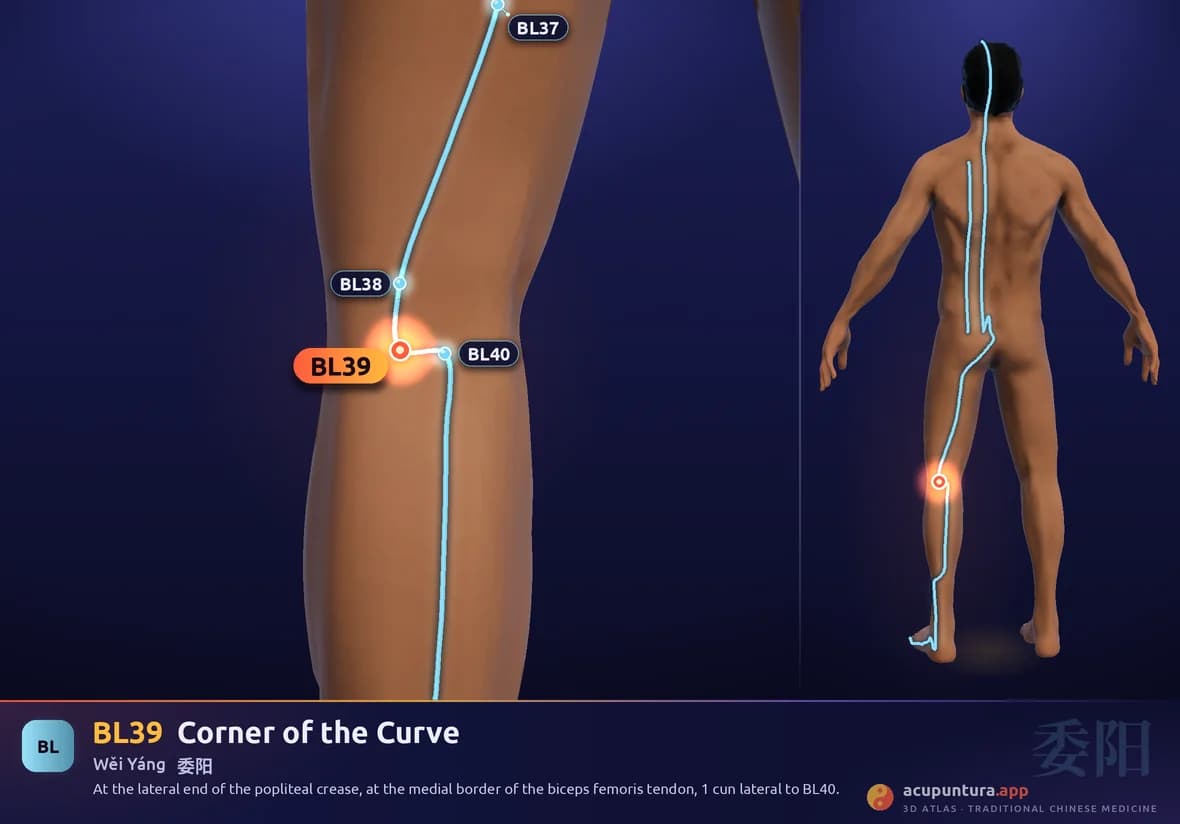
Bladder Channel
Corner of the Curve
委阳Wěi YángAnatomical location
At the lateral end of the popliteal crease, at the medial border of the biceps femoris tendon, 1 cun lateral to BL40.
Main function
Luo-Connecting point of the Triple Energizer, regulates the Lower Jiao, eliminates Dampness, relieves pain.
- Lower He-Sea point of the Triple Energizer
- Crossing Point with the Triple Energizer
Therapeutic indications
- Low back pain
- sciatica
- dysuria
- edema
- leg spasms
- pain in the popliteal crease
- Urinary retention
- Popliteal contracture
- Lumbago
- Abdominal distension
Name and classical tradition
Weiyang, 委阳, is the “Yang of the crease.” 委 means to bend, to fold, and designates the crease of the knee; 阳 (陽) is the outer side. The point is at the outer border of the popliteal fossa, beside BL40, Weizhong, which occupies the center. The two names are understood together.
Its importance is established by the Lingshu (Spiritual Pivot): «三焦合入于委陽», the Triple Energizer unites at Weiyang. It is the Lower He-Sea point (下合穴) of that Fu organ, a fundamental classical doctrine. The chapter Ben Shu (本輸) describes it «膕中外廉», at the outer border of the hollow of the knee. The Zhenjiu Jiayi Jing (Systematic Classic of Acupuncture and Moxibustion) adds «兩筋間», between the two tendons, and the Yixue Rumen (Introduction to Medicine), from the Ming dynasty, «委中外二寸», two cun outside Weizhong. Thus a point of the Bladder channel, at the knee, is the lower meeting place of a Fu organ that is not its own.