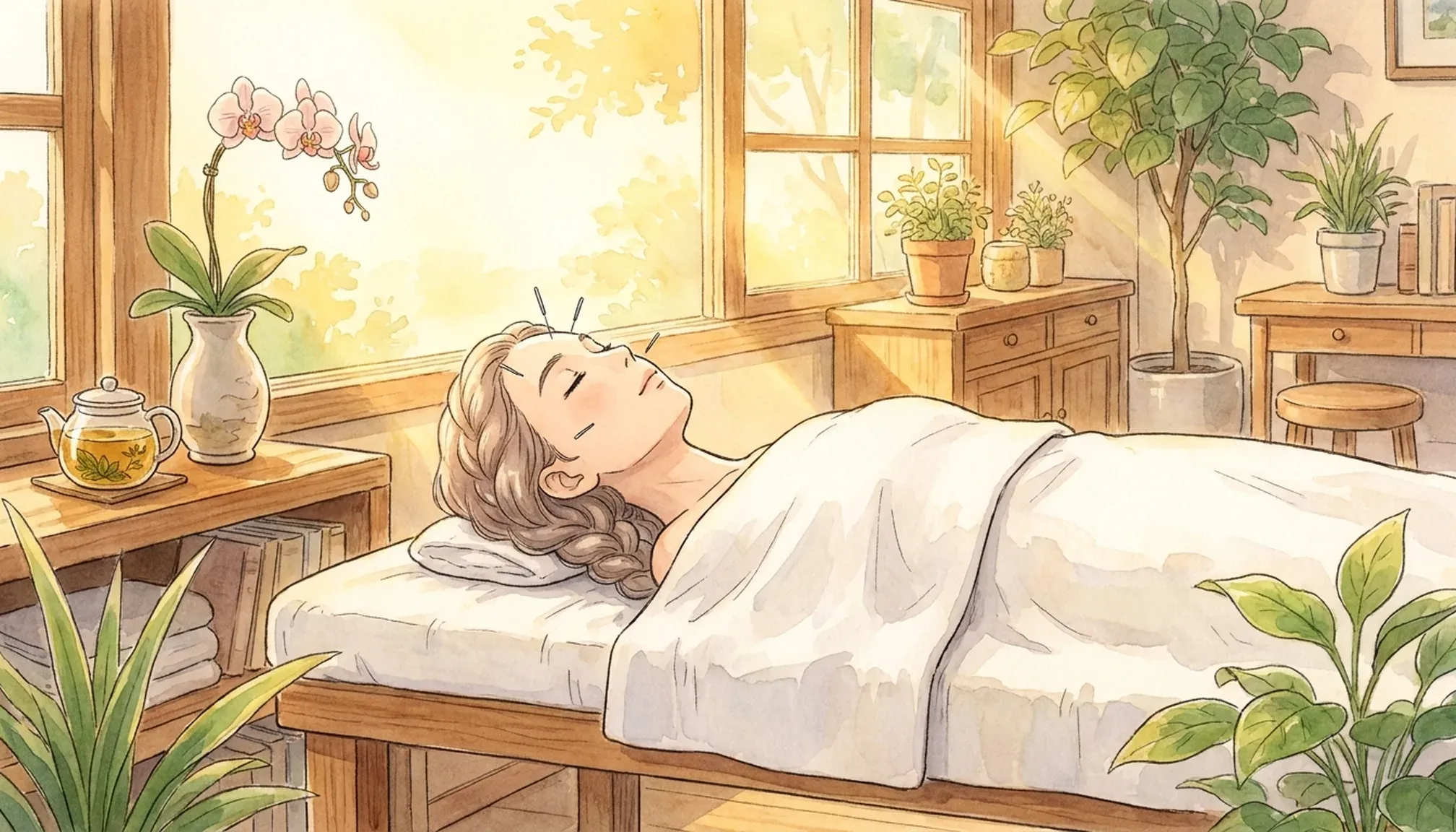
Looking for a natural way to care for your skin without resorting to aggressive treatments? Facial acupuncture, also known as cosmetic acupuncture, is a branch of Traditional Chinese Medicine that uses very fine needles inserted into the face and other areas of the body with a careful aim: to support circulation, bring tone to the skin, and promote a rested look. If you have heard of it but aren't quite sure what it does, or what it doesn't do, this article explains it clearly, without exaggerated promises and with respect for the evidence.
What is cosmetic facial acupuncture?
Acupuncture is an ancient technique of Traditional Chinese Medicine (TCM) that involves inserting extremely fine needles at specific points on the body. When the technique is applied for cosmetic purposes, we call it facial acupuncture or cosmetic acupuncture.
The needles used are much thinner than standard hypodermic needles, and in most cases they are inserted only superficially. The goal is not to cause pain, but a sensation of light pressure or warmth in the area. A session usually lasts between 30 and 60 minutes, and during that time the needles stay in place while the person rests, often lying down.
It's important to make clear from the start that this is a complementary traditional practice, not a medical aesthetic treatment. It doesn't fill wrinkles, it doesn't replace surgery or medical aesthetic procedures, and its results are of a different nature: they focus on the well-being of the skin and its overall appearance, not on transforming the shape of the face.
How does facial acupuncture work according to Chinese medicine?
The face as a reflection of the internal state
According to the Chinese tradition, the face is not seen as an isolated area but as a mirror of the body's overall state. In TCM, a person's skin, circulation, and energy level are related to how they are doing inside: their pace of life, their rest, their diet, their stress level.
From this perspective, when a person is tired, stressed, or sleeping poorly, it tends to show on the face: a dull complexion, dark circles, tension in the features. Facial acupuncture works from this idea: instead of treating the skin as a surface to be "corrected," the aim is to support overall balance, understanding that good circulation and a good energetic tone are reflected in the skin.
Stimulating circulation and skin tone
During a session, inserting the needles produces a subtle local response in the tissues of the face. In plain terms, facial acupuncture aims to:
Stimulate blood circulation in the area, which can bring freshness and a more awake look to the skin.
Support facial muscle tone, gently, helping the face look firmer and more rested.
Release accumulated tension in the jaw, forehead, and around the eyes, areas where many people clench without realizing it, especially during stressful periods.
Promote a general feeling of relaxation, which many people see as a central part of the benefit: a moment of calm that also shows in the face.
This approach explains why those who practice it often talk not only about aesthetics but about well-being: the treatment is approached holistically, that is, considering the person as a whole.
Most commonly used facial acupuncture points
Each practitioner chooses points according to the person, but some appear frequently in cosmetic acupuncture:
On the forehead and eyebrows: Yintang (CP3), the "Hall of Impression," between the eyebrows, widely used to calm the mind; Yangbai (GB14), above the eyebrow; Zanzhu (BL2), at the inner end of the eyebrow; and Sizhukong (TE23), at its outer end.
Under the eyes and on the cheeks: Sibai (ST2), the "Four Whites," and Juliao (ST3), over the cheekbone, associated with puffiness and a dull complexion.
Around the mouth and along the jaw: Dicang (ST4), next to the corner of the lips; Jiache (ST6) and Xiaguan (ST7), in the muscle that works when chewing and that becomes very overloaded in people who clench their teeth.
Points far from the face are often added to these, such as Hegu (LI4), on the hand, or Zusanli (ST36), below the knee, because in Chinese medicine the appearance of the skin depends on overall health, and the Stomach channel, which runs through much of the face, is also worked from the leg.
What facial acupuncture can and cannot offer
It's essential to be honest so you can make a good decision. Facial acupuncture is a traditional practice that, according to those who use it, can help improve the overall appearance of the skin and reduce the feeling of tension. However, it has no miraculous effects and cannot change structural features.
What it can offer
A more rested, radiant look to the skin.
A feeling of relaxation and relief from facial tension.
A complementary, natural, non-aggressive form of care for those who prefer to avoid invasive treatments.
A moment of calm that many people value as a pause within a busy routine.
What it cannot offer
It doesn't fill wrinkles or deep expression lines. There are specific medical aesthetic treatments for that.
It doesn't replace aesthetic medicine or any dermatological treatment. It doesn't remove spots, it doesn't tighten significant sagging, and it doesn't alter the structure of the face.
It doesn't cure skin diseases. If you have dermatitis, severe acne, or any persistent skin condition, the right thing to do is see a dermatologist.
There is no guarantee of results. As with many traditional practices, experience and response vary from person to person, and scientific research on its cosmetic effects is still developing.
What about reducing facial puffiness or facial asymmetry?
Morning puffiness in the face is usually due to fluid retention or poor circulation overnight, not to fat: here the drainage effect of facial acupuncture can show up as a less puffy look, although it is a temporary effect, not a permanent "reduction." With facial asymmetry, it pays to be cautious: if it is mild and linked to muscle tension on one side (for example, clenching the jaw harder on one side when chewing or sleeping), acupuncture can help release that uneven tension; if the asymmetry is structural or from birth, it won't correct it.
The responsible approach is to consider facial acupuncture a complement to skin care, alongside good hydration, sun protection, enough sleep, and healthy habits, and never a substitute for medical advice.
Is cosmetic facial acupuncture painful?
One of the most common questions is whether it hurts. Acupuncture needles are very fine, much finer than the needles used for blood draws. Most people describe the sensation as a slight discomfort as the needle goes in, sometimes as a tingling or a brief pressure, which disappears right away.
The face is a sensitive area, so some points may be felt more than others, but the treatment shouldn't be painful. In fact, many people use the sessions to relax and even take a short nap, something practitioners usually take as a good sign.
How many facial acupuncture sessions are needed?
There is no universal number of sessions, because every person, their skin, and their life circumstances are different. Even so, to give you a general idea, many practitioners usually recommend about 8 to 12 sessions to assess progress, normally at a frequency of one or two sessions a week at the start.
After that, you can move on to maintenance sessions at more widely spaced intervals. It's important to remember that these figures are only a guide, not a promise of results, and that any treatment plan should always be assessed individually with a qualified professional.
Gua sha facial massage and the facial roller: the at-home complement
Between sessions, many people turn to gua sha facial massage. Gua sha is a traditional Chinese technique that involves gliding a flat stone with rounded edges, usually jade or rose quartz, over the skin. On the body it is applied with more pressure, but on the face it is adapted into a very gentle version, meant to relax and support drainage, never to mark the skin.
How to do a facial gua sha step by step
Cleanse your face and apply a few drops of oil or serum so the stone glides without pulling on the skin.
Hold the stone almost flat, tilted about 15 degrees, and always glide from the center of the face outward and from the bottom upward.
Start with the neck, moving downward toward the collarbone, to clear the way for drainage.
Continue along the jaw, from the chin to the ear, and then along the cheekbones, from the nose toward the temple.
Finish on the forehead, from the eyebrows to the hairline, repeating each stroke five to ten times.
The facial roller serves a similar purpose and is easier to start with, though less precise along the jaw. Both can be used daily for a few minutes, always gently: if your skin turns very red, the pressure is too much. Avoid them over inflamed acne, wounds, or active rosacea.
Facial gua sha before and after: realistic expectations
The "before and after" photos that circulate on social media usually show a less puffy face after the massage. That effect is real, but it is temporary: it is mostly due to the movement of fluids and lasts a few hours. With consistency, many people notice their skin looks more relaxed and their jaw feels less tense, which is not nothing, although it won't change the shape of your face or erase wrinkles.
Alongside acupuncture and gua sha, Chinese medicine has other resources for facial care: acupressure, that is, pressing with a fingertip on some of the points mentioned above; facial cupping, small silicone cups that glide gently over the skin; and movement and breathing practices such as qigong and tai chi, which work on the stress that so often shows up in the face.
Who can practice facial acupuncture safely?
Acupuncture should always be performed by professionals with accredited training and experience, who work with sterile, single-use materials and in proper hygienic conditions. On the face we are working on a delicate and visible area, so training and hygiene are especially important.
Before starting any treatment, the practitioner should conduct an initial interview to learn about your health, your habits, and your expectations. If you are pregnant, take anticoagulants, or have any relevant medical condition, it's important to mention it before the first session.
And remember: if you have any persistent or serious symptom, or any skin condition that worries you, see your doctor first. Traditional Chinese Medicine is a complement, never an alternative to medical diagnosis and treatment.
Frequently asked questions
Does facial acupuncture work for wrinkles?
It doesn't fill wrinkles or remove deep expression lines. What it can offer, according to those who practice it, is skin that looks better, more relaxed, and fresher, something many people perceive as a mild rejuvenating effect.
What is facial acupuncture for, and what are its benefits?
It serves as complementary care for the skin and for well-being. Among the benefits people who try it report most often are a more radiant and rested complexion, less puffiness, and less tension in the forehead and jaw, along with a general feeling of calm. It doesn't replace aesthetic medicine or dermatology.
Does cosmetic facial acupuncture really work?
It depends on what you expect from it. As support for relaxing the face and improving the look of the skin, many people are satisfied, especially if they follow the full course of sessions. Research on its cosmetic effects is still limited, so it's wise to be skeptical of any promise of guaranteed rejuvenation.
How long does a cosmetic acupuncture session last?
Normally between 30 and 60 minutes, including the time to place the needles and the rest period while they stay in. The first visit is usually a bit longer because of the initial interview.
Does facial acupuncture have side effects?
When it is practiced with sterile materials by trained professionals, acupuncture is generally a well-tolerated technique. Occasionally, slight redness or small, mild bruises may appear at the needle site, and they disappear within a few days.
Can I combine it with dermatological treatments?
Yes, it is usually compatible, but it's advisable to tell both your dermatologist and your acupuncturist about the treatments you are following, so they can coordinate timing and avoid interference.
Is facial acupuncture the same as cosmetic cupping?
No. Cupping is another traditional Chinese technique that uses suction on the skin, whereas acupuncture uses needles. They are different practices, although they can sometimes be combined at the practitioner's discretion.
Skin care with ancient roots and realistic expectations
Facial acupuncture offers a calm approach that respects the skin, far from the miraculous promises so common in the world of aesthetics. If you are drawn to a vision of self-care that joins well-being and tradition, it can be an interesting experience, as long as you go in with realistic expectations and in the hands of a qualified professional. We encourage you to get well informed, bring up your questions before you start, and, whenever you have doubts about your health, always see your doctor.