Every year, as the days get longer and the trees bloom, millions of people go through the same symptoms again: sneezing, itchy eyes, a stuffy nose, and a tiredness that seems to have no explanation. If you have pollen allergy or allergic rhinitis in spring, you probably know this script by heart. Traditional Chinese medicine (TCM) offers a simple but powerful idea: instead of waiting for symptoms to show up, you can prepare the body weeks ahead so that it responds better when pollen season arrives. In this article we explain why spring allergies come back every year, how TCM understands the problem, and which habits can help you ease it, all in plain language and without jargon.
Why Does Pollen Allergy Come Back Every Spring?
Conventional medicine has a clear explanation for seasonal allergic rhinitis: the immune system, which is in charge of defending us from viruses and bacteria, mistakes pollen for a threat. Pollen is actually harmless, but the bodies of people with allergies react as if it were a dangerous invader. To fight it, the body releases a substance called histamine, which is responsible for most of the symptoms: sneezing, mucus, itching, watery eyes and, in many cases, fatigue and irritability.
The key is that this reaction doesn't go away from one year to the next. The immune system "remembers" the pollen from the previous season and reacts the same way again. That is why spring allergies come back right on schedule, year after year, at roughly the same time. In addition, the high pollen counts of spring, especially on dry, windy, sunny days, make symptoms worse.
From a practical standpoint, this means one important thing: we know well in advance when the problem is going to arrive. And that is where Traditional Chinese Medicine brings an interesting perspective.
How Chinese Medicine Understands Spring Allergies
Traditional Chinese medicine is a health system with thousands of years of history that looks at the body as a whole instead of focusing on an isolated symptom. When a TCM practitioner hears from someone with pollen allergy, they don't think only about the nose: they ask why that person reacts this way and what it says about their overall condition.
In simple terms, TCM holds that the body has a kind of "defensive energy" that acts as a shield against whatever comes from outside: wind, cold, sudden temperature changes or, in this case, the particles in the spring air. When that shield is strong, the body adapts to the changing seasons without trouble. When it is weakened or out of balance, symptoms like those of allergic rhinitis appear.
From this viewpoint, sneezing and mucus are no more than the visible sign of a deeper imbalance: the body isn't handling the change of season or its exposure to the outside environment well. That is why the goal of TCM is not only to relieve symptoms when they appear, but to strengthen that shield in advance so that the reaction is less intense.
It's important to stress that acupuncture and Chinese medicine are understood as a complement, never as a substitute for your doctor or for the treatment they have prescribed. In fact, the World Health Organization recognizes acupuncture as a traditional practice, and research is ongoing into its role in various conditions, including allergic rhinitis.
The Key According to TCM: Prepare the Body Before the Season
Here we come to the central idea of this article. If we know that every spring the body is going to react to pollen, why wait for symptoms to start before acting? Traditional Chinese medicine has defended a very logical principle for centuries: it is easier to prevent an imbalance than to correct it once it has set in.
In practice, this means the best time to start an acupuncture treatment aimed at spring allergies is several weeks before pollen season begins, usually in late winter or at the start of spring. During that period, the TCM practitioner works to strengthen the body's defensive energy and to balance the body overall, so that when the pollen arrives, the response is milder.
It's an approach similar to that of an athlete who trains before a competition: they don't wait until race day to get in shape. In the same way, preparing the body before spring can make a difference in how you experience the season.
What Can You Expect from Preventive Treatment?
A preventive acupuncture treatment is usually planned as several sessions spread over the weeks leading up to the season. The goal is to support the body through the change of season, promote its overall balance, and strengthen its capacity to adapt. Many people who repeat this treatment year after year report that their spring symptoms are more bearable, although each person responds differently and there are no universal guarantees.
In the hands of a qualified professional, acupuncture is a safe and well-tolerated technique, and it can coexist without problems with the medication your doctor has prescribed, such as antihistamines or asthma treatments.
As for the studies, the most frequently cited trial is a German one published in 2013 in Annals of Internal Medicine, with more than 400 people with pollen allergy: those who received acupuncture for eight weeks improved somewhat more in quality of life and used fewer antihistamines than those who received sham acupuncture or only their usual medication. The difference was modest, but real, and it fits with the idea of acupuncture as a complement.
Acupressure for Allergic Rhinitis: Points for the Days with the Most Symptoms
When your nose is blocked or won't stop dripping, some of the points an acupuncturist uses with needles can be pressed with your fingers at home. They don't stop the allergic reaction, but many people notice their nose is a bit clearer for a while:
Yingxiang (LI20), on each side of the nostrils, in the groove. Press both at once with your index fingers, making small circles for one minute.
Yintang (EX-HN3), between the eyebrows. Gentle upward pressure, useful when the forehead feels heavy.
Hegu (LI4), on the back of the hand, between the thumb and index finger. It is the classic distal point for the face and nose. Avoid it during pregnancy.
Fengchi (GB20), at the base of the skull, in the hollows on either side of the neck, for sneezing fits and the feeling of a stuffed-up head.
A saline nasal rinse before pressing helps you notice the effect more. If, besides your nose, you have a cough, wheezing in the chest, or a feeling of shortness of breath, the allergy is affecting your bronchi: that is no longer rhinitis and needs medical evaluation, because it may be asthma.
Habits That Help Ease Allergic Rhinitis in Spring
Besides treatment, Chinese medicine places great importance on daily habits. Some recommendations match common sense and the usual medical advice:
Watch your diet. In the TCM view, very cold foods, too much dairy, and heavy meals can promote the formation of mucus in the body. Choosing cooked, warm, light meals with seasonal vegetables can help the body work better. Drinking room-temperature or warm water is also a common recommendation.
Get enough rest. Tiredness weakens the defenses from any point of view. Sleeping well and keeping regular schedules is one of the simplest ways to support the immune system.
Manage stress. Sustained stress wears the body down and can make allergy symptoms worse. Activities such as walking, mindful breathing, or gentle practices like qigong or tai chi, highly valued in the Chinese tradition, help relax the nervous system.
Reduce your exposure to pollen. On days with high pollen counts, it's a good idea to air out the house first thing in the morning or at the end of the day, avoid hanging laundry outdoors, wear sunglasses to protect your eyes, and shower or wash your face when you get home to remove the pollen that has built up.
Watch for sudden temperature changes. TCM advises protecting yourself from wind and abrupt changes, especially on the neck and back, because it considers these moments when the body is more vulnerable to external factors.
7 Ways to Prevent Allergies Before the Pollen Arrives
The habits above help in the middle of the season, but prevention starts earlier. These seven ways to prevent allergies combine medical advice with that of Chinese medicine:
Know what you're allergic to. Tests with the allergist tell you whether you react to olive, grass, or cypress-family pollen, and each one has its own calendar.
Check the pollen level daily, as you'll see in the next section, to plan your walks, exercise, and airing out the house.
Start medication early if your doctor says so. For many people, starting the nasal spray a few days before the season works better than waiting for the first sneezes.
Create barriers at home and in the car: windows closed while driving, pollen filters in the air conditioning, and street clothes kept out of the bedroom.
Keep your nose clean with saline rinses, which remove pollen before it irritates the mucous membrane.
Prepare the body with Chinese medicine in late winter: preventive acupuncture, moxibustion if the practitioner sees it as suitable, and gentle acupressure at Zusanli (ST36).
Take care of the terrain, as TCM puts it: warm food, enough sleep, little stress, and protection from wind and cold.
How to Find Out Today's Allergy Level
The allergy level on any given day depends on the amount of pollen in the air, and it isn't the same in every city. Aerobiology networks, weather services, and allergy societies publish daily counts and forecasts by area, and many weather apps include them. Pay attention to the type of pollen that affects you, not just the overall level: a day can be high for grasses and low for olive. Dry, windy days tend to push levels up, and light rain brings them down.
Acupuncture Points for Allergies: What the Acupuncturist Works On in the Clinic
The acupressure points you've just seen relieve the nose for a while, but acupuncture treatment for allergies goes beyond the face. Following the logic of Chinese medicine, the practitioner combines local points, which clear the nose, with points that aim to strengthen the defensive energy and the Lung, the organ that TCM associates with the skin, the nose, and breathing. The selection changes from person to person depending on their diagnosis, but some acupuncture points appear often:
Feishu (BL13), the "Back-Shu point of the Lung," on the back, level with the third thoracic vertebra. It is considered the direct access point to the Lung and is one of the most widely used for respiratory allergy.
Fengmen (BL12), the "Wind Gate," just above the previous one. In TCM, wind is the external factor that carries into the body whatever comes from outside, and this point is used to help close the door on it.
Dazhui (GV14), below the most prominent vertebra at the base of the neck, traditionally associated with the body's defenses.
Lieque (LU7), on the wrist, a distal point on the Lung channel that is used when there are sneezing fits and a stuffed-up head.
Quchi (LI11), in the crease of the elbow, added when the allergy also shows up in the skin or the eyes, with itching.
Shangxing (GV23), on the midline of the head, just above the hairline, for persistent nasal blockage.
Zusanli (ST36), below the knee, the great point for strengthening the body in general, very common in the preventive treatments of late winter.
These points are needled in the clinic; don't try to needle them yourself. Some of them, such as Zusanli (ST36) or Quchi (LI11), can indeed be pressed gently at home as a complement to the facial points.
Moxibustion and Auricular Therapy for Allergies
Chinese medicine has two other techniques that often accompany needles. Moxibustion consists of applying heat with a dried herb, mugwort, burning near the skin. It is mainly reserved for people whose allergy gets worse with cold, with clear, abundant mucus and a feeling of fatigue, and it is usually applied on points of the back or on Zusanli (ST36). It is not suitable when there is a lot of heat, red eyes, or thick, yellowish mucus, and it should always be indicated by the practitioner.
Auricular therapy stimulates points on the ear with fine needles or with small seeds taped on with adhesive tape, which the person presses several times a day between sessions. It is a convenient way to prolong the effect of the treatment during the weeks of heaviest pollen.
Types of Rhinitis and Their Symptoms: What Causes Rhinitis
Rhinitis is a medical condition, yes, although it is often experienced as a simple nuisance: the term refers to inflammation of the mucous membrane lining the inside of the nose. Not all rhinitis is allergic, and telling them apart matters, because each one is treated differently.
Etiology of Rhinitis: The Most Common Types
When a doctor talks about the etiology of rhinitis, they mean its cause. The most common forms are these:
Seasonal allergic rhinitis, the spring kind: sneezing, clear mucus, and itchy nose and eyes that coincide with the pollination of trees and grasses.
Perennial allergic rhinitis, which lasts all year because it is triggered by indoor allergens, such as dust mites, molds, or pet dander. It tends to cause more congestion than sneezing.
Infectious rhinitis, the kind that comes with a cold, caused by viruses. It lasts a few days and can come with fever, sore throat, or general malaise.
Non-allergic or vasomotor rhinitis, in which the nose reacts to temperature changes, strong odors, smoke, or air conditioning without any allergy being involved.
Medication-induced rhinitis (rhinitis medicamentosa), a rebound effect from using decongestant sprays for too many days, which end up leaving the nose even more blocked.
Hormonal rhinitis, common in pregnancy, which usually goes away after delivery.
Why Does Allergy Happen?
Allergy arises from the combination of a predisposition, often hereditary, and repeated exposure to a substance. On first contact the immune system becomes "sensitized" and produces antibodies against that pollen or that mite; on later contacts, those antibodies trigger the release of histamine and the symptoms appear. That is why allergy doesn't always show up in childhood: it can begin in adulthood, when you move to a new city or change your surroundings.
The Origin of Rhinitis According to Chinese Medicine
Chinese medicine describes rhinitis as the entry of external Wind, sometimes with Cold and sometimes with Heat, into a body whose defensive energy fails to hold it back. Behind it, it usually sees a weakness of the Lung, which governs the nose; of the Spleen, which when weakened generates Dampness and mucus; or of the Kidney, which TCM associates with the inherited constitution. This reading doesn't replace a medical diagnosis, but it explains why the acupuncturist asks about digestion, tiredness, or feeling cold, and not just about the nose.
Symptoms of Rhinitis and How to Treat It: Medicine and Chinese Medicine
The symptoms of allergic rhinitis are easy to recognize: sneezing fits, especially on waking, clear and watery mucus, a blocked nose, itching in the nose, palate, or eyes, watery eyes, and often tiredness and poorer sleep at night. If the mucus becomes thick and greenish, or there is fever or facial pain, it may be an infection rather than an allergy.
To fight allergy, conventional medicine offers antihistamines, corticosteroid nasal sprays, and in some cases immunotherapy, which is the closest thing to acting on the cause. Which medicine for rhinitis or allergy suits you is something your doctor decides, ideally after tests that confirm what you're allergic to. Chinese medicine fits in as a complement: acupuncture, acupressure, and habits to ease the allergy and prepare the body, without withdrawing anything your doctor has prescribed.
What to Do If You Have an Allergy: The First Steps
An allergy doesn't go away overnight, but it can be controlled quite well. If you suspect you have one, this is a reasonable order of steps:
See your family doctor or an allergist to confirm that it is an allergy and what you're allergic to, usually with skin tests or a blood test.
Reduce contact with what triggers it: pollen in spring, mites at home, smoke, or stuffy environments.
Do saline nasal rinses, which flush out pollen and mucus in a simple way.
Take the medication you're prescribed. For allergy, oral antihistamines are usually used and, for rhinitis, corticosteroid nasal sprays; a pharmacist can guide you in a mild case, but if symptoms come back every year, have your doctor evaluate it.
Ask about immunotherapy if the allergy is intense: it is the treatment that comes closest to getting rid of the allergy, because it gradually accustoms the immune system to the allergen.
If you're interested in Chinese medicine, add preventive acupuncture, acupressure, and the habits you've seen in this article as a complement.
Complications of Rhinitis When It Isn't Controlled
Poorly controlled allergic rhinitis is more than a nuisance. A mucous membrane that stays inflamed for weeks promotes sinusitis and, in children, ear infections. A blocked nose worsens sleep, increases snoring, and leaves a tiredness that drags on through the day, with poorer concentration at work or in class. The eyes often join in with allergic conjunctivitis, and over the years nasal polyps can appear in some people. The most important complication is asthma: the nose and bronchi form a single airway, and anyone with allergic rhinitis has a higher risk of developing it. That is why it's wise to treat it properly from the start and to seek care without waiting if you develop a persistent cough, wheezing in the chest, facial pain with fever, or ear pain.
Natural Treatment for Allergies: How to Control Rhinitis Day to Day
Many people look for something for allergies that isn't just a pill, and that is understandable. It's worth saying clearly from the start: no natural remedy cures allergy, but several simple measures can help you control rhinitis and need less medication, always with your doctor's approval.
What to Take for Rhinitis Naturally
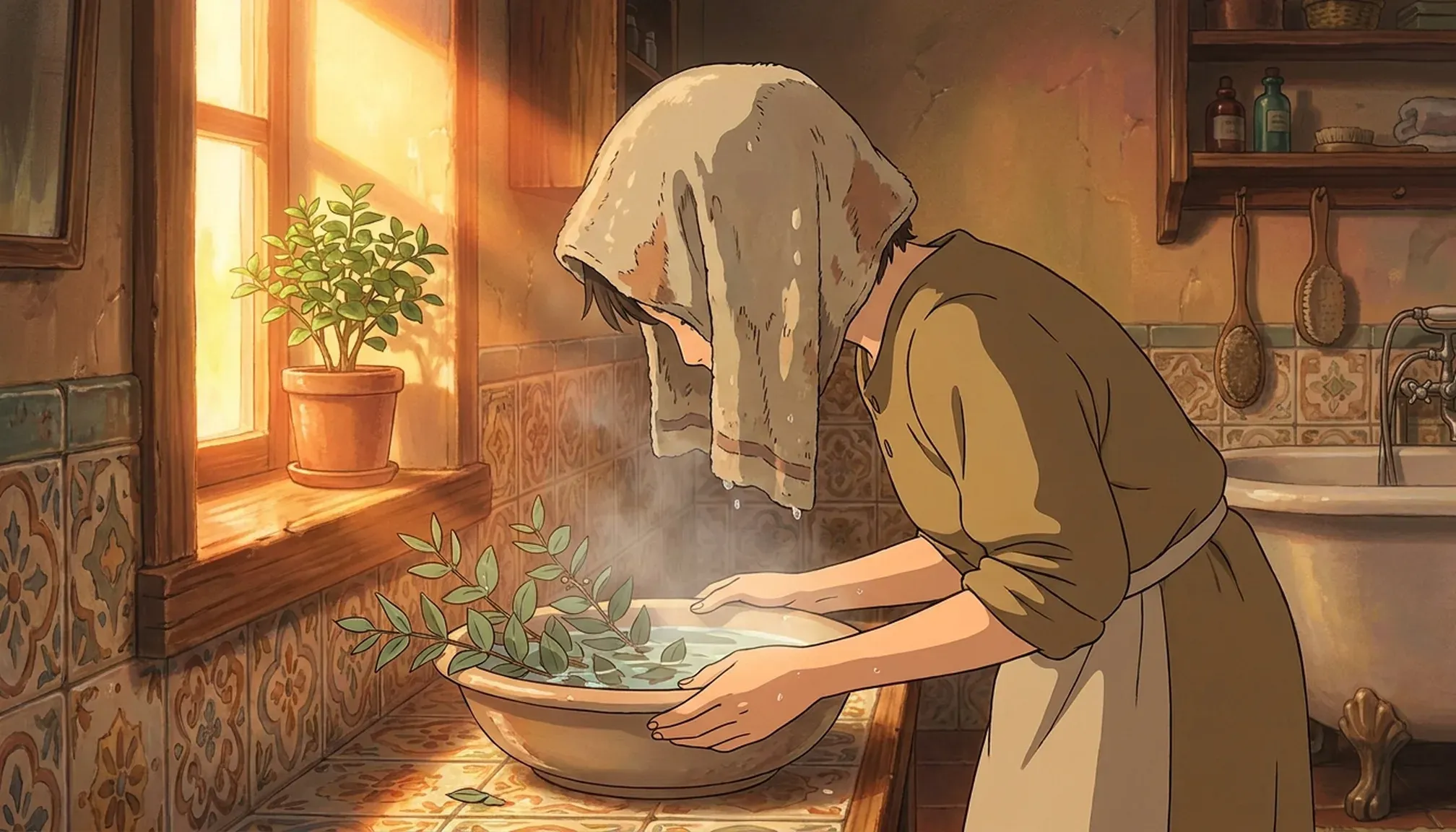
What works best is also the most humble. Saline nasal rinses, once or twice a day during the season, remove pollen before it irritates the mucous membrane. Breathing the steam from a bowl of hot water, taking care not to burn yourself, helps loosen mucus when your nose is blocked. Drinking warm liquids throughout the day, such as water, broths, or mild herbal teas, keeps mucus thinner, which matches the Chinese medicine advice to avoid very cold things.
In Chinese medicine, fresh ginger tea is used when rhinitis comes with a feeling of cold, chills, and clear mucus, and it is avoided when there is a feeling of heat, a red throat, or yellow mucus. It is an example of how TCM adapts each measure to the type of person and not to the name of the disease.
Natural Medicine for Allergies: Chinese Herbs and Formulas
Chinese herbal medicine has classic formulas designed to strengthen the defensive energy, such as the one known as "Jade Windscreen" (Yu Ping Feng San), traditionally used in people who catch colds easily and react to every change in the weather. These are preparations with real effects on the body, not harmless teas: they should be prescribed by a Chinese medicine practitioner trained in herbal medicine, who knows your diagnosis and the medication you take. That caution is even greater during pregnancy, breastfeeding, with children, or if you take anticoagulants. Be wary of products that promise to cure allergy in a few weeks.
How to Control Rhinitis with Chinese Medicine Throughout the Year
Controlling rhinitis doesn't start in spring. TCM proposes a calendar: preventive acupuncture and moxibustion, if the practitioner recommends it, in late winter; acupressure at Yingxiang (LI20) and Hegu (LI4) on the days with the most symptoms; auricular therapy seeds to prolong the effect between sessions; and, all year round, warm food, good rest, and protection from wind and cold. Combined with medical treatment, this approach aims to make each season a little more bearable.
What Happens When There Is an Allergy in the Body: Skin, Food, and Specialist
Pollen allergy is the best known, but the mechanism is the same when the allergen is a food, a metal, or a cosmetic. Understanding what happens when there is an allergy helps you know what to expect and whom to see.
What an Allergy Feels Like
When the body comes into contact with the substance it is sensitized to, certain cells release histamine within minutes. Blood vessels dilate, mucous membranes swell, and nerve endings become irritated. That is why an allergy feels like an itch that won't let up, a tickle in the nose or palate, eyes that burn or water, skin that is hot or covered in hives and, often, a diffuse tiredness, like coming down with something but without fever. If the reaction affects the throat or breathing, or spreads through the whole body with dizziness, it is no longer a nuisance: it is an emergency.
Skin Allergy: Hives, Eczema, and Itching
On the skin, allergy usually shows up in two ways. Urticaria means raised, reddish welts that itch a lot, move around, and disappear within hours. Contact dermatitis, on the other hand, leaves a red, dry area, or one with small blisters, right where something touched the skin, such as a metal, a perfume, or a detergent. People with allergic rhinitis are also more prone to atopic eczema.
Chinese medicine sees the skin and the nose as territories of the Lung, so it isn't surprised that allergy jumps from one to the other. It interprets itching as Wind and redness as Heat in the Blood, and among the points an acupuncturist usually considers are Quchi (LI11) and Xuehai (SP10), the "Sea of Blood," on the inner thigh, above the knee.
Remedies for Allergy on the Body
For itchy skin, simple measures help: lukewarm showers that aren't too long, mild unscented soaps, daily moisturizing, cotton clothing, and short nails so you don't scratch. Cold compresses relieve hives for a while. At home you can press Quchi (LI11) with your thumb for one minute on each arm when the itching gets intense. Antihistamines and corticosteroid creams, if needed, are prescribed by your doctor.
Treatment for Food Allergy
Food allergy is different and more delicate. It can cause itching in the mouth, hives, vomiting, or stomachache, but also a severe reaction within minutes. Its treatment is, above all, to avoid the responsible food completely once it has been confirmed with tests, to always read labels and, if the allergist advises it, to carry an epinephrine auto-injector. In some cases there are desensitization treatments under strict medical supervision. Neither acupuncture nor any herb replaces any of this: Chinese medicine can support delicate digestion, but it doesn't make it safe to eat the food again.
Which Specialist Treats Allergies
The allergy specialist is the allergist, who performs the tests, identifies the allergen, and decides whether immunotherapy is appropriate. The usual path starts with the family doctor, who refers you to the allergist when needed. For the skin, a dermatologist may also get involved and, if your nose stays blocked despite treatment, an ear, nose, and throat specialist. The acupuncturist, if you want to add one, works as a complement to them.
Diagnosing Rhinitis: What Type of Allergy Do I Have and When Does It Start
Awareness days such as World Allergy Day serve each year to remind us of something many people overlook: a large share of people with allergies live with symptoms without knowing exactly what they react to. And without that information it is hard to control the allergy, because you don't know what to avoid or when to get ahead of it.
When Allergy Starts Depending on the Pollen
Allergy doesn't start on the same day for everyone: it depends on the pollen that affects you and where you live. In much of Spain, cypress-family trees can cause trouble as early as late winter; plane trees, in cities, at the start of spring; grasses, from mid-spring to early summer; and olive, in late spring in the south and center. In the Southern Hemisphere the calendar is reversed, and the allergy spring arrives around September and October. Allergies to mites, molds, or animals, on the other hand, don't follow seasons and are felt all year, often worse in fall or when cleaning the house. Noting down which weeks your symptoms begin is a very useful clue for your doctor and for planning preventive acupuncture.
How Rhinitis Is Diagnosed
Diagnosing rhinitis begins with a conversation: what symptoms you have, at what time of year, in which places they get worse, and whether there are allergies in your family. The doctor looks inside the nose and, if allergy is suspected, the allergist runs the tests that answer the question of what type of allergy I have. The most common is the skin test, the prick test: drops of different allergens are placed on the forearm, the skin is pricked very superficially, and within minutes you can see which ones produce a wheal. When the skin doesn't allow it, or there are doubts, a blood test is used that measures the antibodies against each allergen. If the nose stays blocked despite treatment, the ear, nose, and throat specialist may examine it with a thin endoscope to rule out a deviated septum or polyps.
Chinese medicine runs its own assessment in parallel: it observes the tongue, takes the pulse, and asks about cold, digestion, sweating, or tiredness to decide whether Wind with Cold or with Heat predominates, or a weakness of the Lung or Spleen. It is a complementary reading that guides the points and the habits, not a substitute for allergy tests.
Allergy Medicine for Children: What to Keep in Mind
With children it's wise to be especially cautious. Not all antihistamines are approved for every age, and the dose is calculated by weight, so allergy medicine for children is always chosen by the pediatrician or the allergist, who usually prescribe it as a syrup or drops. Never give a child an adult's allergy medication by splitting the pill, or decongestant sprays without a prescription. Saline nasal rinses, adapted to their age, are safe and very useful.
With children, Chinese medicine prefers gentle techniques: massage and acupressure with light pressure, such as a soft massage at Yingxiang (LI20) on either side of the nose, and, if a practitioner with pediatric experience sees it as suitable, short sessions. Chinese herbs and formulas, in children, only with professional guidance.
Can Acupuncture Replace Antihistamines?
No. The responsible answer is clear: acupuncture does not replace medical treatment. Antihistamines, nasal sprays, and immunotherapy (allergy shots) are tools of conventional medicine with specific indications, and only a doctor can decide whether they are appropriate in each case.
What acupuncture can do is accompany that treatment: many people use it as a complement to feel better overall, with the idea of a body that is more balanced and prepared. If you have spring allergies, the sensible thing is to talk to your doctor first, especially if your symptoms are intense, you have difficulty breathing, or you suspect allergic asthma, and then consult a qualified acupuncture practitioner if you want to explore TCM's preventive approach.
Frequently asked questions
When Should I Start Acupuncture Treatment for Spring Allergies?
Ideally, according to traditional Chinese medicine, you begin several weeks before pollen season starts, usually in late winter. Starting earlier lets you prepare the body and strengthen its capacity to adapt to the change of season, instead of acting only once symptoms have already appeared.
Can Acupuncture Cure Pollen Allergy?
You can't speak of a cure. Acupuncture is a complement that can help relieve symptoms and prepare the body before the season, but it doesn't eliminate the allergy or replace medical treatment. The response, moreover, varies greatly from one person to another.
Is Allergic Rhinitis Curable?
Allergic rhinitis is usually a chronic problem: it is controlled more than it is cured. With medical treatments, and especially with immunotherapy when the allergist prescribes it, many people improve a lot. Acupuncture can help make symptoms more bearable, but it doesn't eliminate the allergy.
What Is the Treatment for Allergy?
Allergy treatment rests on three pillars: avoiding the allergen, relieving symptoms with antihistamines, nasal sprays, or creams, and, in the indicated cases, the immunotherapy prescribed by the allergist. Acupuncture, acupressure, and the habits of Chinese medicine can be added as a complement, never in place of the above.
How Do You Cure Rhinitis?
It depends on its cause. Rhinitis from a cold clears up by itself in a few days, and medication-induced rhinitis usually improves when you stop the decongestants with your doctor's help. Allergic rhinitis, on the other hand, is controlled more than cured, with medical treatment, nasal rinses, and less contact with the allergen.
What Do You Take for Allergy?
The most common are antihistamines, which block the effect of histamine, and corticosteroid nasal sprays when a blocked nose predominates. For the eyes there are specific eye drops. It's best to have your doctor or pharmacist choose the rhinitis medication and the dose, especially if you're pregnant, have other conditions, or take other medication.
What Are Allergies?
Allergies are an exaggerated reaction of the immune system to substances that are harmless in themselves, such as pollen, mites, pet dander, or certain foods. The body mistakes them for a threat and releases histamine and other substances that cause sneezing, itching, mucus, watery eyes, or hives. They can appear at any age and often have a family component.
What Does an Allergy Look Like?
It depends on where it shows up. In the nose it looks like redness around the nostrils from blowing it a lot, and a nasal voice; in the eyes, like swollen eyelids, red watery eyes, and dark circles; on the skin, like raised itchy welts or red, dry patches. If the lips, tongue, or face swell, or breathing is difficult, it is a medical emergency.
What Types of Rhinitis Are There?
The main ones are allergic rhinitis, seasonal or perennial; infectious, typical of a cold; non-allergic or vasomotor, which reacts to temperature changes and odors; medication-induced, from overuse of decongestants; and hormonal, common in pregnancy. Knowing which one you have guides the treatment, so it's worth having your doctor evaluate it.
Why Do Allergies Happen?
Allergies happen when the immune system mistakes a harmless substance, such as pollen, for a threat and reacts against it. Family heredity, repeated exposure to the allergen, and the environment, such as pollution or living in a city, all play a part. Chinese medicine adds its own reading: a weak defensive energy, linked to the Lung, that fails to adapt to changes in the outside world.
What Kind of Doctor Treats Allergies?
The doctor for allergies is the allergist, who confirms the diagnosis with tests and decides the treatment, including immunotherapy. The usual route is to start with the family doctor, who refers you to the specialist. Depending on the affected area, the ear, nose, and throat specialist or the dermatologist may also get involved, and the acupuncturist only as a complement.
Is There a Natural Medicine for Allergy?
There is no natural medicine that cures allergy. Nasal rinses, warm herbal teas, and acupressure can help relieve rhinitis, and Chinese herbal medicine formulas are used to strengthen the defenses, but always prescribed by a trained professional, because they interact with other drugs. None of them replaces the medication your doctor prescribes.
How Can I Find Out What Type of Allergy I Have?
The reliable way is to see your family doctor, who will refer you to the allergist. There, skin tests on the forearm or a blood test show whether you react to grass, olive, or cypress-family pollen, to mites, to molds, or to animals. Knowing this lets you avoid the allergen, start medication early, and consider immunotherapy.
How Can I Control Allergy in the Middle of the Season?
To control allergy, combine several things: take the medication your doctor has prescribed regularly and not only on bad days, do nasal rinses, air out the house during the hours with the least pollen, and shower when you get home. Acupressure and the habits of Chinese medicine can be added as a complement. If hives or itching spread over your whole body, or you have trouble breathing, go to the emergency room.
Which Acupuncture Points Are Used for Allergy?
The most common ones combine points on the nose, such as Yingxiang (LI20), with points that strengthen the Lung and the defenses, such as Feishu (BL13), Dazhui (GV14), or Zusanli (ST36). The specific combination depends on each person's diagnosis, and needles should only be placed by a qualified professional.
Is Acupuncture Safe for Allergic Rhinitis?
When performed by a qualified professional, with sterile single-use needles, acupuncture is generally a safe and well-tolerated technique. Even so, you should always tell your doctor that you are receiving this type of treatment, especially if you take medication.
Which Foods Should I Avoid in Spring If I Have Allergies?
From the perspective of Chinese medicine, it is recommended to moderate very cold foods, too much dairy, and heavy meals, because they can promote mucus. A warm, cooked, light diet is preferable. If you have specific questions about your diet, consult a health professional.
Does Acupuncture Help Even If Pollen Season Has Already Started?
Yes, although the approach changes. If the season has already begun, treatment is aimed at relieving current symptoms rather than preventing them. Even so, many people decide to start preventive treatment the following year, with more lead time.
Conclusion: Getting Ahead of It Is the Best Strategy
Spring allergy comes back every year, but that is also an advantage: we know when it's going to arrive and we can prepare. Traditional Chinese medicine reminds us that caring for the body before symptoms appear, combining treatment with healthy habits, can change how you experience pollen season. If you suffer from allergic rhinitis and want to learn about the preventive approach of acupuncture, we encourage you to consult a qualified Chinese medicine practitioner, always in coordination with your doctor. Getting ahead of it, after all, is the smartest way to take care of yourself.