It starts quietly: a small yellowish spot at the tip of the nail. Months later, the nail is thickened, brittle, frayed, and a color that is no longer its own. Nail fungus (onychomycosis) is one of the most common and most stubborn health problems there is: it is estimated to affect one in ten people, and conventional treatment is long, with variable results and frequent relapses. If you have been battling it for a while, this article is for you: we explain what it is, why it is so hard to get rid of, and what Traditional Chinese Medicine can offer as support.
What is nail fungus?
Onychomycosis is a fungal infection of the nails, caused mostly by fungi called dermatophytes, although yeasts and molds can also be responsible. The fungi settle into the keratin of the nail (the very material it is made of), where they feed and multiply, causing the typical changes:
Color change: yellowish, whitish, brown, or even dark.
Thickening of the nail plate, sometimes making it hard to trim.
Brittleness and fraying: the nail crumbles at the edges.
Separation of the nail from the nail bed (onycholysis) in advanced cases.
Unpleasant odor in some cases.
It usually begins at the free edge of the nail and advances toward the base. The infection is more common in toenails than in fingernails, precisely because of the environment it finds inside shoes: warmth, moisture, darkness.
Why is it so hard to get rid of?
If you know someone who has had nail fungus (or you have had it yourself), you know what comes next: months of treatment, medicated nail polishes, pills, and often, the return of the problem. The reasons are structural:
The nail is difficult territory. Topical medications penetrate poorly through a thickened nail plate, and oral ones require months of treatment and are not free of side effects.
Fungi are tenacious. Their spores survive in shoes, on the surfaces of shared showers, and on bath mats, which explains reinfections.
Personal factors that help it persist: age (peripheral circulation worsens), diabetes, closed shoes, very sweaty feet, repeated trauma to the nail (sports, tight shoes), and a weakened immune system.
That last point is key to understanding the Traditional Chinese Medicine view: the fungus matters, but so does the terrain in which it thrives.
The Traditional Chinese Medicine view: dampness, heat, and terrain
Traditional Chinese Medicine does not speak of "fungi" in the microbiological sense (its frame of reference is different), but it describes with surprising accuracy the conditions in which this kind of problem appears and persists.
Dampness that accumulates
In traditional language, nail fungus falls within the territory of "Dampness" and "Damp-Heat": fluids that stagnate in the lowest parts of the body, in the densest tissues, and that create the perfect environment for the organisms modern medicine calls opportunistic to proliferate. It is a coherent picture: sweaty feet, closed shoes, a humid environment. The tradition describes the same ecosystem that mycology does.
Heat and inflammation
When the infection is active, with redness of the surrounding skin, itching, or discomfort, traditional terminology speaks of Dampness that "heats up": the stagnation becomes inflamed. And when the process becomes chronic, the Dampness settles in and the tissue becomes dense and altered: the nail thickened, deformed, "like stone."
The terrain: why some people and not others
Here is the most interesting contribution of Chinese medicine to this problem: the question is not only "how do I kill the fungus?" but "why does my body offer a terrain where it thrives?" From this perspective, a tendency toward internal Dampness, sluggish circulation in the extremities, digestion that generates Dampness, chronic fatigue that weakens the defenses, and habits that keep the feet damp are all part of the picture. Working on the terrain is what separates an approach that merely puts out the fire from one that aims to keep it from coming back.
The feet in Traditional Chinese Medicine
To understand why Chinese medicine pays so much attention to diseased nails, it helps to know the place the feet hold in its map of the body. In Traditional Chinese Medicine, the feet are not just the base we walk on: they are the point where six of the twelve main channels begin or end, the pathways through which, according to this tradition, qi (vital energy) and Blood circulate.
Six channels that begin or end in the feet
Three Yin channels start in the foot and ascend along the inner side of the leg: the Spleen, Liver, and Kidney channels. Three others, Yang, descend along the outer and back side to end at the toes: the Stomach, Gallbladder, and Bladder channels. The toenails thus sit at the end of these pathways, in the area farthest from the center of the body, where qi and Blood arrive with less strength.
This image helps explain the traditional reading of the problem. When the Spleen, the organ that in Chinese medicine is in charge of transforming food and fluids, works with difficulty, the Dampness that is not processed tends to sink downward and stagnate in the legs and feet. And when the Blood of the Liver, which according to the tradition nourishes the tendons and nails, is scarce or circulates poorly, the nails become dry, brittle, and dull. Feet that are cold, heavy, or swollen at the end of the day are part of the same picture.
Points on the foot used in the clinic
That is why it is not unusual for the practitioner to work points on the foot and ankle itself, in addition to those on the leg. Among them are Taichong (LR3), on the top of the foot between the first and second toes, used to move the qi and Blood of the Liver; Taixi (KI3), next to the medial malleolus, linked to the deep energy of the Kidney; and Zulinqi (GB41), on the top of the foot, which the tradition associates with pain and discomfort in this area. On the sole is Yongquan (KI1), the first point of the Kidney channel, well known for its use in foot massage.
The choice always depends on the individual assessment: a person with sweaty, hot feet is not the same as one with cold, pale feet and brittle nails.
Caring for your feet at home according to Chinese medicine
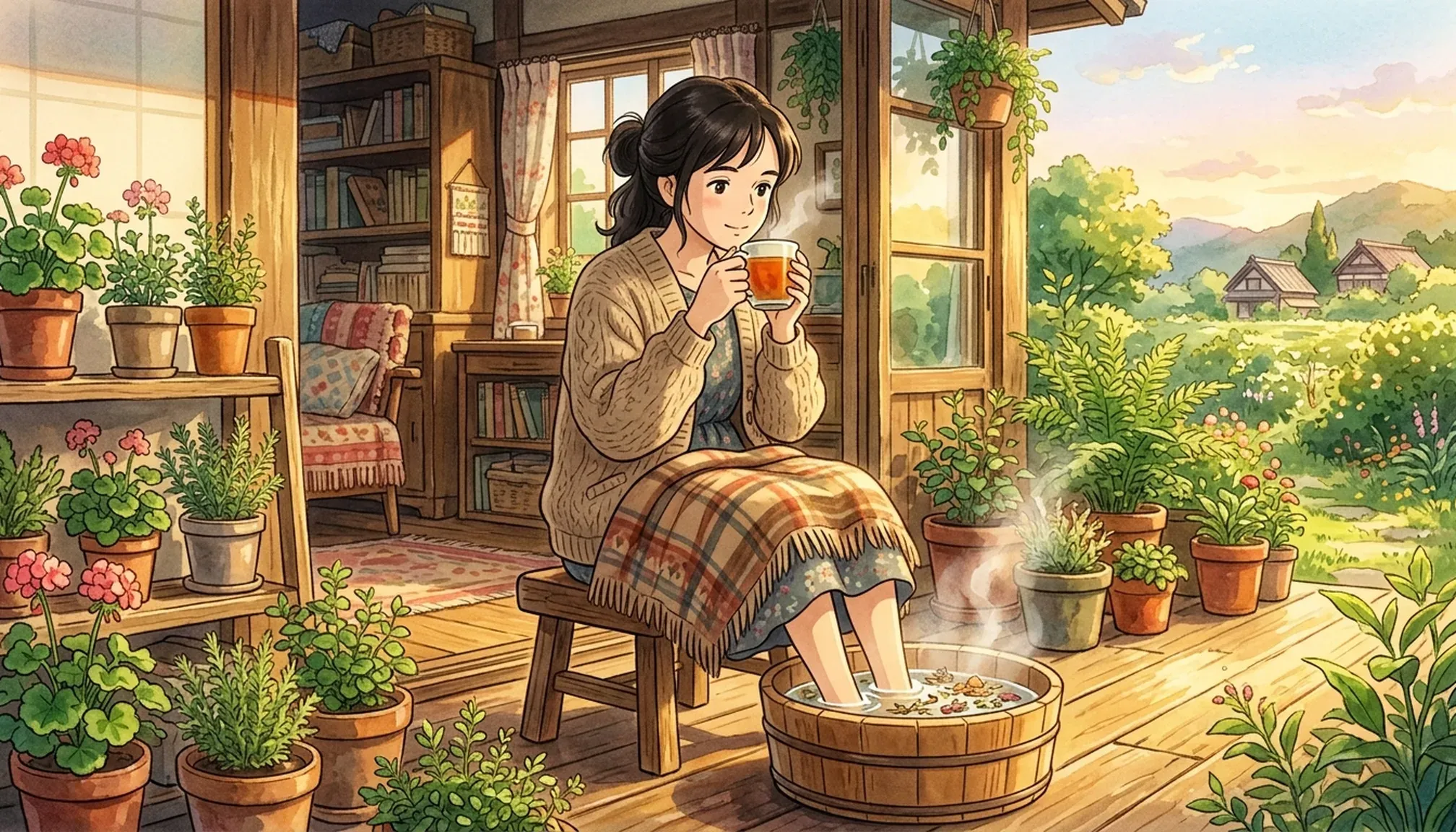
The tradition suggests a few simple practices you can add to your routine, always as a complement to medical treatment. A foot bath in lukewarm water, thoroughly dried afterward, helps relax the area and activate circulation. Gentle acupressure at Taichong (LR3) or Yongquan (KI1), with the thumb for one or two minutes, is another common practice. Do it only on healthy skin: do not press or massage over an infected nail or cracked skin, and do not share towels or basins. If you have diabetes or poor circulation, or if you are pregnant, check first with your doctor or a qualified acupuncturist.
What does the Chinese medicine approach involve?
Traditional treatment is conceived as a complement to medical treatment (never as a substitute for antifungals when they are indicated) and works on several fronts:
Acupuncture. Aimed at activating circulation in the extremities, promoting the drainage of Dampness, and supporting the body's overall defenses. Among the classic points for Dampness that sinks into the legs are Yinlingquan (SP9) and Sanyinjiao (SP6), both on the inner side of the leg. Good circulation in the feet and hands is also what allows topical treatments to reach the area better.
Chinese herbal medicine. The tradition has herbal formulas with bitter, drying plants that, within its framework, act on internal Dampness and Heat. The practitioner personalizes them and reviews them periodically. It must be said clearly: they do not replace the antifungal, but they can support the process from within.
Traditional foot baths and external applications. Some clinics complement treatment with specific herbal foot baths, aimed at keeping the area dry and hostile to the fungus. A qualified practitioner will advise you on what to use and how.
Lifestyle advice. Controlling moisture in your footwear, hygiene, eating to reduce internal Dampness, and looking after circulation are all part of the plan.
What results can I expect?
Honesty above all: nail fungus is one of the slowest problems to resolve in any therapeutic framework, and Traditional Chinese Medicine is no exception. What is reasonable to expect:
Support for conventional treatment: better circulation in the area, better tolerance of the process, and work on the terrain that helps resist relapses.
Improvement of the environment that favors the fungus: less sweaty feet, healthier tissue around the nail, corrected habits.
A long timeline: we are talking months, not weeks, just as with conventional medical treatment. A big toenail takes more than a year to grow out completely.
Frequently asked questions
Are antifungals and Chinese medicine compatible?
Yes. In fact, the combined approach is the most sensible: the antifungal attacks the fungus, and Chinese medicine works on the terrain and circulation. Always coordinate both with your practitioners, and do not stop a prescribed medical treatment on your own.
Does acupuncture help if only one toe is affected?
Yes. Even if the focus is local, acupuncture works both globally and locally: the circulation of the extremities, the state of the defenses, and internal balance are addressed together.
How many sessions are needed?
Usual protocols propose weekly sessions during the first few weeks, which are then spaced out. But let's be clear: the real timeline of the process is set by the growth of the nail, not by the sessions. Think in terms of months of support.
Can I prevent it from coming back?
Yes, and it is the most important part. Prevention measures drastically reduce relapses: breathable shoes, cotton socks changed daily, feet thoroughly dried (especially between the toes), not walking barefoot in shared showers, disinfecting your footwear, and taking care of any trauma to the nail.
How are the feet related to the organs according to Traditional Chinese Medicine?
In Traditional Chinese Medicine, the feet are the starting or ending point of six main channels: Spleen, Liver, Kidney, Stomach, Gallbladder, and Bladder. That is why the state of the feet and nails is interpreted as a reflection of how qi and Blood reach the extremities, and of how the body handles Dampness. It is a traditional way of reading the body that does not replace a medical diagnosis.
Can I do acupressure on my feet if I have nail fungus?
Yes, with caution. You can gently press points such as Taichong (LR3), on the top of the foot, always on healthy skin and away from the affected nail. Wash your hands before and after so you do not spread the infection, and avoid massaging if there are cracks, wounds, or redness. If you have diabetes or circulation problems, check with your doctor first.
Daily care against fungus
These measures, recommended by conventional dermatology, are the foundation of any strategy:
Dry your feet well after washing them, paying special attention between the toes.
Wear breathable shoes and alternate pairs so each one airs out for 24 hours.
Change your socks daily (more often if you sweat a lot).
Do not share nail clippers, files, towels, or shoes.
In pools, gyms, and shared showers, wear flip-flops.
Trim your nails straight across and avoid shoes that press on the tip.
Treat athlete's foot if you have it: it is usually the gateway for fungus to reach the nails.
Check your feet if you are diabetic or have poor circulation: in these cases, any nail or skin injury should be evaluated by a professional.
In summary
Nail fungus is a slow, tenacious, recurring enemy that demands a strategy to match: medical treatment when indicated, patience measured in months, strict hygiene, and work on the terrain that favors it. Traditional Chinese Medicine contributes precisely this last front: understanding why your body offers a welcoming environment to the fungus, and supporting its transformation from within and from without. There are no miracle shortcuts, but there is a complete path. And walking it with a healthy nail and well-cared-for feet is worth it.