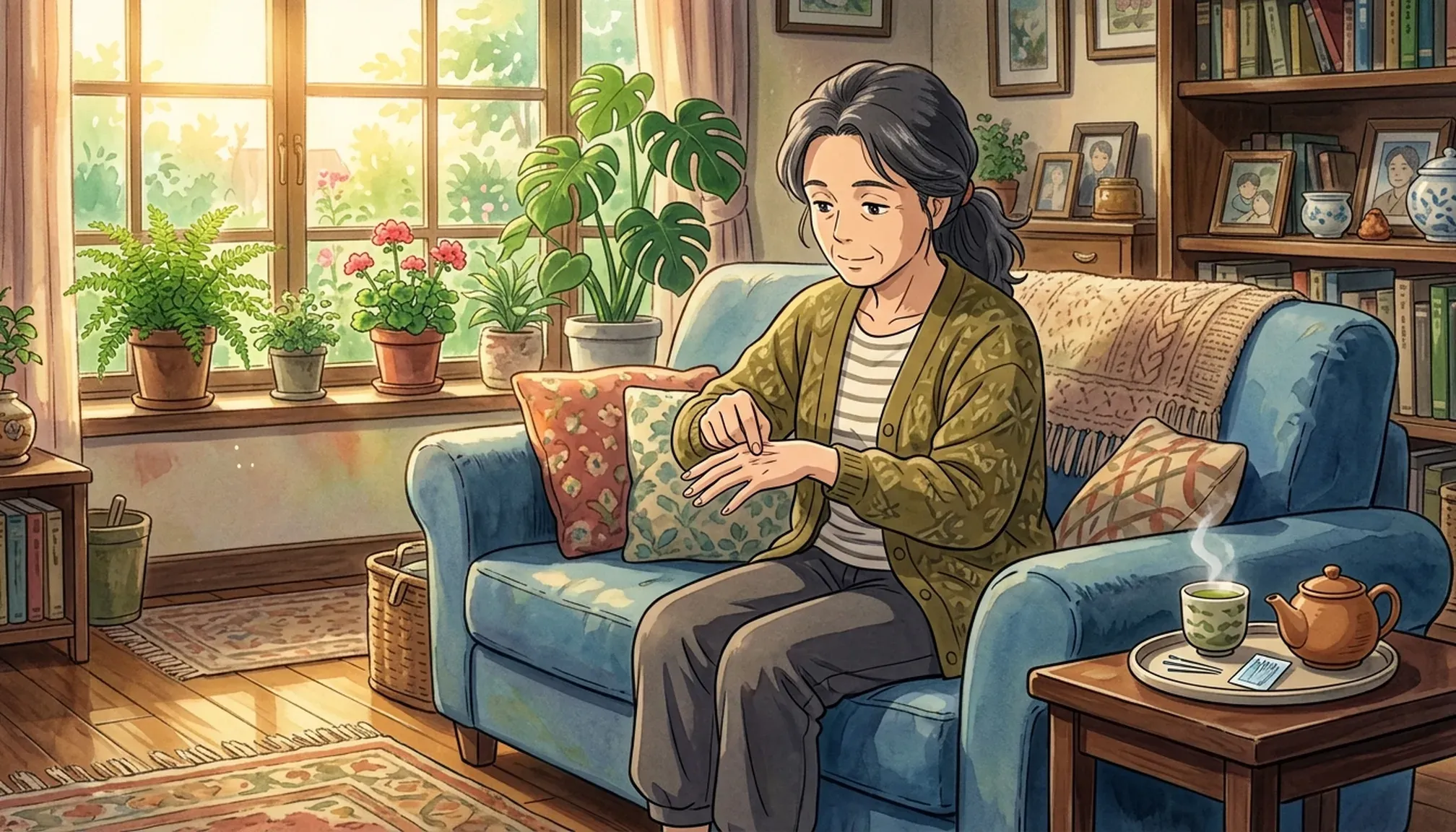
You're in the back seat of a car on a winding road, or you've just woken up with an upset stomach, or yesterday's meal sat worse than you expected, and all you want is for that feeling to settle. Acupressure for nausea is a simple remedy that many people know from travel wristbands: you press a specific point on the inner side of the wrist with your fingers, with no needles and no equipment, anytime and anywhere.
In this article we explain where that point is and how to find it, how to press it step by step and for how long, the situations in which it is usually used, what we know (and don't know) about how well it works, and when it's time to stop self-care and seek professional advice. We present it as a complement for mild discomfort, never as a substitute for a medical evaluation.
Where Is the Nausea Point and How Do You Find It?
The best-known nausea point in Traditional Chinese Medicine (TCM) is called Neiguan (PC6), a name that can be translated as "inner gate." It belongs to the Pericardium channel (also called the Heart Protector), one of the channels through which, according to TCM, Qi, the vital energy that runs through the body, flows. In the Acupuncture Atlas on Acupuntura.app, it is associated with nausea, vomiting, motion sickness, and morning sickness in pregnancy, as well as with other chest and sleep complaints.
Finding it at home is easy if you follow this order:
Rest your forearm palm up on a table or on your thigh.
Make a loose fist and bend your wrist slightly: you'll see two long tendons stand out in the center of the inner wrist.
Place three fingers of your other hand (index, middle, and ring) together and horizontally, with the edge of the ring finger on the crease where the wrist bends.
The point sits just above the edge of the index finger, in the hollow between the two tendons, along the line running up toward the elbow.
When you press there, you'll notice the sensation is different from the rest of the forearm: it is usually a somewhat deeper pressure, sometimes with a dull ache or a slight tingling. That's the sign you're in the right area. You don't need to be precise to the millimeter: it's a small area, not a pinpoint, and being a few millimeters above or below doesn't invalidate the technique.
How Do You Do Acupressure on the Wrist Step by Step?
Wrist acupressure is a gentle technique, and you can learn it in a minute. Here is a common way to do it:
Sit comfortably and breathe calmly. If you're in a vehicle, try to keep your eyes fixed on the horizon and get some fresh air.
Find the point by following the steps above.
Press with the pad of the thumb of your other hand, perpendicular to the skin, until you feel firm but bearable pressure. It should not hurt sharply.
Hold the pressure or make small, slow circles, without sliding your finger over the skin.
Continue for one to three minutes, breathing slowly, and then rest for a few seconds.
Repeat on the other wrist. Many people work both sides, although if you notice relief on one you can start there.
There is no "official" duration that guarantees results. As a practical guideline, sessions of a few minutes are usually recommended, and you can repeat them whenever the discomfort returns. If your skin becomes irritated, or if you feel intense tingling or pain in the wrist, stop and don't push it.
What About Anti-Nausea Wristbands?
Anti-nausea wristbands are elastic bands with a small plastic bead or button that sits over that same area of the wrist and applies continuous pressure without you having to do anything with your fingers. They're convenient for long trips because they keep your hands free. For them to make sense, the button must sit over the hollow between the tendons, three fingers' width from the wrist crease; if it is displaced, the pressure doesn't land where it's meant to. As with any product, it's best to buy them from reputable stores and not expect more from them than they can give.
When Is Acupressure for Nausea Used?
These are the situations in which this technique is used most often:
Motion sickness. In a car, boat, or bus, many people apply the point or wear a wristband preventively, before the discomfort starts, in addition to the usual measures: looking straight ahead, getting fresh air, and not reading.
Mild nausea after a heavy meal. When the stomach feels overloaded or digestion is slow, gentle pressure on the wrist can go along with other measures, such as drinking a warm herbal tea or resting while seated.
Nausea from anxiety or nerves. Sometimes the discomfort arrives before a stressful situation. The slow breathing that naturally accompanies acupressure already helps on its own.
Nausea when getting up in the morning. It is common in some people and, as we'll see, also in pregnancy.
Acupressure for Nausea in Pregnancy
First-trimester nausea is very common, and it is one of the reasons many pregnant women look for drug-free alternatives. Acupressure for nausea in pregnancy, specifically at the Neiguan (PC6) point or with wristbands, is considered a low-risk option for mild discomfort, and it is one of the most frequently discussed in the clinic.
Even so, extra caution is called for in pregnancy. Before you start, talk to your midwife or doctor, especially if you vomit often. And keep in mind that acupuncture with needles during pregnancy should always be performed by a professional with specific training, who adapts the points and the timing; it is not something to improvise. At home, limit yourself to gentle pressure on the wrist.
Are There Other Acupuncture Points for Nausea?
Besides Neiguan, TCM uses other points when there is digestive discomfort. Two of the most frequently cited are Zhongwan (CV12), on the midline of the abdomen, halfway between the breastbone and the navel, and Zusanli (ST36), on the leg, below the knee. Both are related to the Stomach: the first to nausea, vomiting, and heavy digestion, and the second to digestion in general and fatigue. From the TCM point of view, nausea is understood as "Stomach Qi" that, instead of descending normally, flows in the opposite direction; these points are used to help redirect it.
For self-care, the wrist is the simplest and most comfortable area. The other points are usually worked in the clinic, where a professional locates them precisely and evaluates your case as a whole. In the clinic, you can also turn to auricular therapy, which involves stimulating points on the ear with fine needles, seeds, or light pressure, as a complement for nausea and other digestive symptoms.
Acupuncture, Auricular Therapy, and Reflexology for Nausea
Acupressure at home is only one way of working with these points. When nausea keeps coming back, many people ask about other techniques offered in the clinic. They all share the same approach: to support medical treatment, not replace it.
Acupuncture Points for Nausea in the Clinic
In an acupuncture session for nausea, the practitioner usually starts with Neiguan (PC6) and adds other points depending on the pattern they observe. In addition to Zhongwan (CV12) and Zusanli (ST36), it is common to use Shangwan (CV13), a little above Zhongwan on the midline of the abdomen, associated in the Atlas with nausea, vomiting, and reflux, and Weishu (BL21), on the back, on both sides of the spine, which is the Back-Shu point of the Stomach, that is, the one TCM links directly to that organ. They are needled with fine, sterile needles, sometimes with a little heat, and the combination varies from person to person. That's why it makes no sense to copy a list of points or try to reproduce the session at home.
Auricular Therapy for Nausea
Auricular therapy is based on the idea that the ear reflects the entire body, so each zone of the outer ear corresponds to an organ. For nausea, the main area stimulated is the one that corresponds to the stomach, near the center of the ear, where the fold that begins at its edge ends, along with areas used for calming. The practitioner often leaves small seeds taped in place so the person can press them for a few seconds several times a day, which is practical when traveling or during longer treatments. Research on auricular therapy for nausea is still scarce, so it is best seen as one more form of support.
Reflexology for Nausea
Foot reflexology is not part of Chinese medicine, although it is often offered alongside it. It works with pressure on areas of the sole of the foot that, according to this method, correspond to different organs. For nausea, the reflexologist usually focuses on the inner arch of the foot, below the pad of the big toe, which is associated with the stomach, and on the center of the sole, an area used for relaxation. Many people find it pleasant and soothing, which already helps when nausea comes with nerves, but there is no solid evidence that it acts on the stomach. In pregnancy, talk to your midwife first.
Does It Also Help With Vomiting or Mild Diarrhea?
Neiguan (PC6) is not just the nausea point: in TCM it is used equally for acupressure for vomiting, both to prevent vomiting and to calm the urge to vomit once it has started. The technique is the same as for nausea—firm, sustained pressure for one to three minutes, breathing slowly—and it is usually repeated more often during the acute episode. There is no separate point "to stop vomiting": it is this same one, worked with a bit more persistence.
For the mild diarrhea that sometimes accompanies digestive upset, acupressure plays a more secondary role. Points such as Zusanli (ST36), below the knee, or Tianshu, next to the navel (we cover it in detail in the article on acupressure for gas), are used in TCM to support digestion as a whole, but they do not replace oral rehydration or a medical evaluation if the diarrhea persists, is profuse, or comes with a fever.
What Is Nausea and How Does It Feel?
Nausea is that unpleasant feeling in the upper stomach and throat that signals your body may want to vomit. It is not a disease in itself but a symptom: it can appear because of motion sickness, a meal that doesn't agree with you, a stomach infection, pregnancy, anxiety, a migraine, or as a side effect of some medications.
Everyone describes it in their own way, but some features recur. It feels like an upset or "empty" stomach, often with more saliva than usual, frequent swallowing, cold sweats, pallor, mild dizziness, and an aversion to food or certain smells. It can last a few minutes or stay with you for hours in waves that come and go.
I Feel Nauseous but Don't Vomit: Is That Normal?
Yes, it's the most common situation. Nausea and vomiting are related, but often the feeling stays at that stage without leading to vomiting, and it passes on its own when the cause eases: when you get out of the car, when digestion finishes, or when your nerves settle. From the TCM point of view, this discomfort without vomiting is understood as Stomach Qi that tends to rise but without enough force to expel the contents; that's why it is worked on gently, aiming to get it descending again. If nausea without vomiting lasts several days, appears every morning for no apparent reason, or comes with any of the warning signs you'll see below, talk to your doctor.
Causes of Nausea: Why It Happens
Nausea occurs when the brain receives signals that something is wrong and prepares the body for a possible vomit. These signals can come from the stomach and intestines, when they are irritated or too full; from the inner ear, when what you feel as you move doesn't match what your eyes see, as happens in a car or on a boat; from the blood, when substances such as alcohol, some medications, or certain hormones are circulating; and from the brain itself, with stress, fear, intense pain, or a migraine. That's why the causes of nausea are so varied, and why the same measure doesn't work equally well in every case.
Among the most common triggers are motion sickness, large or fatty meals, stomach infections, excess alcohol, pregnancy, anxiety, migraines, reflux, and the side effects of drugs such as some antibiotics, painkillers, or cancer treatments.
Causes of Constant Nausea
When nausea isn't a one-off but comes back almost daily for weeks, it's worth considering causes that persist over time: gastritis or reflux, a medication taken continuously, a pregnancy not yet confirmed, sustained anxiety, gallbladder, liver, or kidney problems, thyroid or blood sugar disorders, and, less often, other conditions that only a doctor can rule out. Constant nausea always deserves a medical visit, because acupressure may ease the feeling but tells you nothing about its origin.
Morning Nausea: The Most Common Causes
Morning nausea has some causes of its own. The best known is pregnancy, especially in the first weeks, although it can actually occur at any time of day. An empty stomach after many hours without eating, reflux that rises when you lie down, a heavy dinner or the previous night's alcohol, postnasal drip in colds and allergies, lack of sleep, and tension about the day ahead also play a part. Eating something dry and light as soon as you get up, such as toast or plain crackers, helps many people start the day with a calmer stomach.
How Chinese Medicine Explains Nausea
For TCM, the Stomach's function is to receive food and make it "descend"; when that movement is reversed, nausea appears. The reasons it considers are several: food that stagnates and isn't digested, a weakness of the Spleen and Stomach that makes digestion slow, "Dampness" and Phlegm that accumulate, or the Liver, disturbed by emotions, "invading" the Stomach, which shows up in the nausea that comes with nerves or upsets. Depending on the pattern, points such as Liangmen (ST21), in the upper abdomen, or Zhangmen (LR13), on the side of the body, below the tip of the last ribs, are added to Neiguan (PC6) in the clinic. Choosing and combining them is a professional's job.
What to Do for Nausea: How to Ease and Manage It at Home
When nausea is mild and you know where it comes from, there are simple measures you can combine with wrist acupressure to help it settle:
For a moment, sit or lie down slightly propped up and avoid sudden movements.
Breathe slowly through your nose, lengthening the exhale; slow breathing helps calm the sensation.
Seek fresh air and move away from strong smells, such as food, perfume, or tobacco.
Drink fluids in small, frequent sips, preferably lukewarm or cool rather than very cold.
When you feel like eating, start with something dry and plain, in small amounts, and avoid anything greasy, heavily spiced, or alcoholic.
Acupressure fits in well here because it forces you to stop and breathe. In addition to Neiguan (PC6), in TCM it is often combined with Gongsun (SP4), on the inner edge of the foot, behind the joint of the big toe, a point associated in the Atlas with vomiting, indigestion, and stomach pain. You can press it gently in the same way, although it is usually best to have a professional recommend its use.
What Can You Take for Nausea? Medication and Treatment
There are medications for nausea, called antiemetics, but not all of them work for every cause, and some are not suitable in pregnancy, for children, or alongside other drugs. That's why the medication for nausea should be chosen by your doctor or, in mild cases, discussed with your pharmacist, and you shouldn't take anything on your own if the nausea keeps coming back. Treatment for nausea really depends on its origin: motion sickness is not the same as gastroenteritis or a side effect.
Mild herbal teas, such as ginger or chamomile, are comforting for many people, but ask first if you are pregnant or taking medication. Chinese herbs and formulas should only be prescribed by a professional.
When nausea comes along with dizziness, as on trips, or with stomach pain, the temptation is to look for a single medication to cover everything. But that pain could be due to gastritis, an infection, or something that needs to be examined, and masking the symptoms can delay the diagnosis. Tell your pharmacist or doctor exactly what you feel, since when, and what other drugs you take.
Natural and Home Remedies for Nausea
Home remedies for nausea don't act on the cause, but they can make mild, passing discomfort more bearable. Most are based on the same principles as acupressure: calm, small amounts, and not forcing the stomach.
Tea and Herbal Teas for Nausea
More than tea in the strict sense, what usually helps are mild, lukewarm herbal teas sipped slowly. Ginger is the most popular natural remedy for nausea; chamomile and mint are also used for their digestive and soothing effect. Drink them weak and without rushing. Ginger may not be suitable if you take anticoagulants or have severe reflux, and in pregnancy any herb should be checked first. A very strong black or green tea, on the other hand, can irritate an already upset stomach.
What to Eat When You Feel Nauseous
With an upset stomach, the best approach is to eat little and often. Dry, neutral-tasting foods are usually well tolerated, such as toast, plain crackers, white rice, boiled potato, banana, or baked apple, as well as mild broths. It's best to avoid fried foods, fats, spicy dishes, strongly scented meals, and carbonated or alcoholic drinks, and not to lie down right after eating. From the TCM point of view, these guidelines protect the Spleen and Stomach, which do better with warm, easily digested foods than with cold, raw, or heavy ones.
Nausea in Children: Treatment and Care
In children, nausea usually comes with gastroenteritis, car sickness, or nerves. Treatment mainly consists of offering fluids in small, frequent sips, preferably pharmacy oral rehydration solution rather than juices or soda, and letting them eat again when they feel like it, without forcing them. Don't give them medication for nausea without the pediatrician's go-ahead, because several of those used by adults are not suitable at their age. Wrist acupressure can be done as a quiet game, with very light pressure. Seek care right away if the child seems listless, isn't urinating, vomits everything they drink, has a high fever, or has a stomachache that doesn't ease; in babies, dehydration sets in faster.
Nausea in Medical Terminology
In medical language, nausea is the unpleasant sensation of an imminent need to vomit, and vomiting is the expulsion of stomach contents through the mouth. The medications that combat them are called antiemetics. That's why you often read "nausea and vomiting" or simply "no nausea" in a report, which indicates that the symptom has not appeared.
What Does the Evidence Say About Acupressure for Nausea?
It's important to be honest: acupressure for nausea is one of the most researched uses of Chinese medicine, and even so the results are limited. There are numerous studies on the wrist point, especially for nausea and vomiting after surgery, with chemotherapy, and in pregnancy, and some of them point to a possible benefit. However, the studies vary in quality and size, it is hard to design a convincing "placebo" for pressure on the skin, and the conclusions of the reviews are cautious.
What can be said in general terms is the following:
It is a safe, inexpensive technique for healthy people, with very few adverse effects, such as mild discomfort or redness where it is pressed.
Some people report relief and others notice nothing; there is no way to predict who will respond.
Part of the effect may come from the attention, breathing, and calm that go along with the technique, which doesn't make it any less useful as a wellness tool.
It does not replace antiemetics or other treatments your doctor prescribes, and you should never stop a medication on your own.
That's why we recommend it as support, not as a solution: it can help ease mild discomfort, not treat the underlying cause.
When to See a Professional
Acupressure is for occasional, mild discomfort. See your doctor if any of these situations arise:
- Vomiting that repeats for more than a day or keeps you from holding down fluids.
- Signs of dehydration: very dry mouth, scant dark urine, dizziness when standing up, marked weakness.
- Pregnancy with frequent vomiting, weight loss, or being unable to eat or drink normally.
- Severe abdominal pain, high fever, blood in the vomit, or black stools.
- Sudden, severe headache, stiff neck, or confusion along with the nausea.
- Persistent nausea with no clear cause, or nausea that appears after starting a new medication.
- Nausea accompanied by chest pain, cold sweats, or shortness of breath, which require urgent attention.
If you have a pacemaker, a wrist injury, or an underlying condition, or if you take anticoagulants, check with your doctor before using wristbands or applying sustained pressure. In children, always use much gentler pressure and check with the pediatrician.
Frequently asked questions
Does acupressure for nausea and vomiting really work?
Some people report relief from mild nausea, but the evidence is limited and uneven. It is a safe remedy that can go along with other measures. If the vomiting is repeated or you can't keep fluids down, acupressure isn't enough: see your doctor to assess the cause and prevent dehydration.
How long should you press the wrist point?
As a guideline, one to three minutes on each wrist, with firm pressure but no pain, breathing slowly. You can repeat it whenever the discomfort returns. There is no official duration that ensures results, so go by what feels comfortable and stop if you notice pain or tingling.
Can you use acupressure for nausea in pregnancy?
It is considered a low-risk option for mild nausea, whether with gentle pressure or with wristbands. Even so, talk to your midwife or doctor, and seek care without delay if the vomiting is frequent or you can't eat or drink normally.
Does acupuncture work for nausea, or only acupressure?
Both work on similar points. Acupuncture, performed by a professional with sterile needles, has been used as a complement for nausea of various origins, with promising but limited results. Acupressure is gentler and can be done at home. In pregnancy, acupuncture should always be performed by someone with specific training.
Does auricular therapy work for nausea?
Auricular therapy stimulates points on the ear, and some practitioners use it as a complement for digestive complaints. The research is still scarce, so it can't be considered a solution. If you're interested, see a qualified professional, who will assess your case individually.
Is moxibustion used for nausea?
Moxibustion, which applies heat from dried mugwort near the skin, is used in the clinic when the practitioner interprets that there is "Cold" in the Stomach, with nausea, slow digestion, and relief from warmth. Points such as Zusanli (ST36) or Zhongwan (CV12) are usually chosen. It is not something to do without guidance, or during pregnancy without supervision.
What should you do if you have nausea that won't go away?
If the nausea lasts more than a day or two, keeps coming back, or doesn't let you drink, stop self-care and see your doctor to find the cause. In the meantime, drink in small sips, rest, and watch for signs of dehydration. Acupressure can go along with this, but it doesn't replace that evaluation.
What can I take for nausea without a prescription?
Pharmacies carry over-the-counter medications for nausea, especially for motion sickness, but they aren't suitable for everyone: some cause drowsiness, and others are not recommended in pregnancy, for children, or with certain treatments. Ask your pharmacist for advice, tell them what you take, and, if the nausea keeps coming back, see your doctor.
How do you get rid of nausea quickly?
There is no instant remedy that always works, but many people find that nausea eases when they stop, sit down, breathe slowly while lengthening the exhale, get some fresh air, and drink small sips of fluid. Pressing Neiguan (PC6) on the wrist for a few minutes fits well with those measures. If it doesn't ease or gets worse, seek care.
Where do you place anti-nausea wristbands?
On the inner side of the wrist, with the button over the hollow between the two tendons, about three fingers' width above the wrist crease. If the button sits too close to the hand or off to one side, the pressure doesn't reach the point. They should be snug without being too tight.
How do you spell "nausea" and its related words?
The word is "nausea," with the stress on the first syllable ("NAW-zee-uh" or "NAW-zhuh"), and the plural, "nauseas," is rarely needed because it is normally used as an uncountable noun. A common mistake is confusing "nauseous" and "nauseated": strictly speaking, "nauseated" describes the person who feels sick, while "nauseous" (or "nauseating") describes what causes the feeling, although in everyday speech both are used for the person. From the same root comes "nauseating," said of whatever provokes disgust.
What is the medical term for nausea?
In medicine the same word, "nausea," is used for the feeling that you are about to vomit. Vomiting is also called "emesis," which gives us "antiemetic," the medication that combats it, and "hyperemesis gravidarum," the intense, persistent vomiting of pregnancy. "Retching" (or "dry heaves") refers to the effort to vomit without bringing anything up, and the nausea-causing dizziness of car or boat travel is called "motion sickness" or "kinetosis."
Why do I feel nauseous if I haven't eaten anything unusual?
Nausea doesn't always come from the stomach. It can be due to an empty stomach, anxiety, lack of sleep, a migraine, reflux, a medication, or a pregnancy not yet confirmed. Notice when it appears and what goes along with it. If it keeps coming back without a clear cause or lasts several days, see your doctor to assess its origin.
What home remedy for nausea can I try in the morning?
Many people feel relief if they eat something dry and light before getting up, such as plain crackers, sit up slowly, and then sip a lukewarm herbal tea. You can add a few minutes of pressure on Neiguan (PC6). If morning nausea keeps coming back unexplained, take a pregnancy test if there's a chance you could be pregnant, and see your doctor.
In Summary
Acupressure for nausea is a simple, safe gesture within everyone's reach: find Neiguan (PC6) three fingers' width from the wrist crease, between the two tendons, and press it gently for a few minutes while you breathe calmly. It can keep you company through motion sickness, heavy digestion, or the mild nausea of pregnancy, although the available evidence is limited and not everyone notices the same effect.
Use it for what it is, a support for passing discomfort, and not as a substitute for medical care. If the vomiting persists, if there are signs of dehydration, or if you are pregnant and can't keep food down, see a healthcare professional as soon as possible.