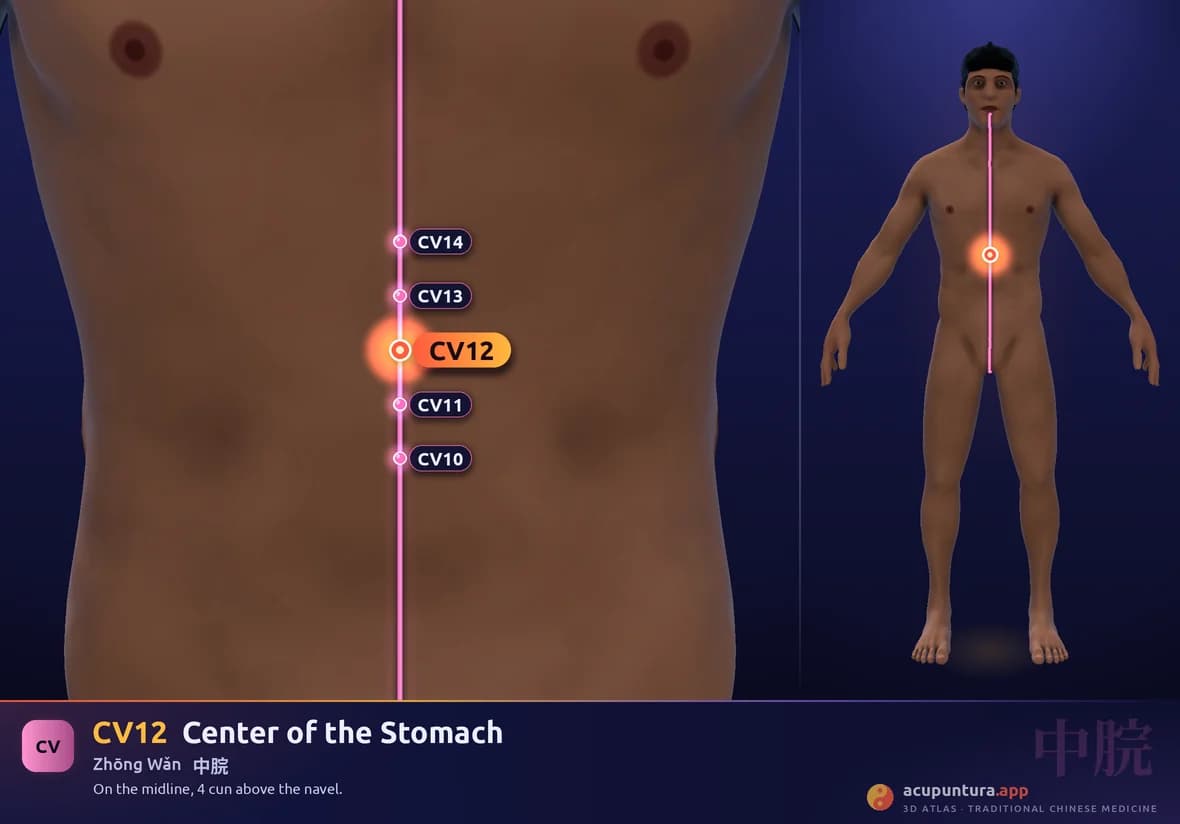
Ren Mai (Conception Vessel) Channel
Center of the Stomach
中脘Zhōng WǎnAnatomical location
On the midline, 4 cun above the navel.
Main function
Regulates the Stomach and Spleen, eliminates stagnation.
- Stomach Front-Mu point
- Influential (Hui) point of the Fu organs
- Crossing point with the Small Intestine and Triple Energizer
Therapeutic indications
- Stomach pain
- nausea
- vomiting
- abdominal distension
- heartburn
- indigestion
- poor appetite
- diarrhea
- constipation
- insomnia
- dizziness
- profuse expectoration
- Ménière's disease
- diabetes mellitus (Xiao Ke)
- obesity and overweight
- hyperlipidemia (high cholesterol and triglycerides)
- irritable bowel syndrome
- ulcerative colitis and Crohn's disease
- fatty liver
- gallstones and biliary colic
- gastroesophageal reflux
- polycystic ovary syndrome
- chemotherapy-induced nausea and vomiting
Name and classical tradition
Zhongwan, 中脘, is the "Center of the Stomach." 中 is the center; 脘 is the gastric cavity. It lies at the midpoint of the epigastric region, between CV13 and CV10, and the name is transparent.
Its most meaningful alias is 太倉, the "great granary." The Lingshu (Spiritual Pivot), in the chapter Zhang Lun (脹論), says "胃者,太倉也," the stomach is the great granary, and the Nanjing (Classic of Difficulties), in Difficulty 45, when listing the eight Influential Points, places the meeting of the Fu organs in that granary: "腑會太倉." Those texts speak of the concept, but tradition identified the taicang with this point, which is the Influential (Hui) point of the Fu organs (腑會) and the Front-Mu point (募穴) of the Stomach. It is worth distinguishing between the origin of the concept and the origin of the point's name.
Wang Shuhe's Maijing (Pulse Classic) writes it 中管, and the sources are divided between that work and the Zhenjiu Jiayi Jing (Systematic Classic of Acupuncture and Moxibustion) as the first mention. The reference works also record 上紀, 胃脘, and minor graphic variants such as 胃管 or 三管.
Other names
- 太倉Jiayi Jing